Quick Answer: An automobile insurance declarations page is a summary of the policy that was actually issued. It generally identifies the policyholder, insured vehicles, policy dates, coverage limits, deductibles, optional benefits, discounts, and premium.
Your declarations page is one of the most important insurance documents you have. It is also one of the first documents, along with the accident report, that Galbavy Law will want to review as part of handling your case. It can help you determine whether you purchased bodily injury liability coverage, property damage liability coverage, uninsured and underinsured motorist protection, Medical Payments coverage, collision coverage, comprehensive coverage, and rental reimbursement.
However, the declarations page is only a summary. The complete policy forms and endorsements control the precise scope of coverage, definitions, exclusions, duties, and limitations.
An automobile insurance declarations page, commonly called a declarations page or dec page, summarizes the most important information about an issued automobile insurance policy.
It generally identifies:
The declarations page is not the entire insurance contract. It usually does not contain every definition, exclusion, condition, or limitation that may affect a claim. The complete policy may include the declarations page, policy forms, endorsements, amendments, and other documents issued by the insurance company.
The North Carolina Department of Insurance explains the principal types of automobile insurance coverage and recommends reviewing the complete policy or contacting the insurance agent to identify applicable limitations and exclusions.
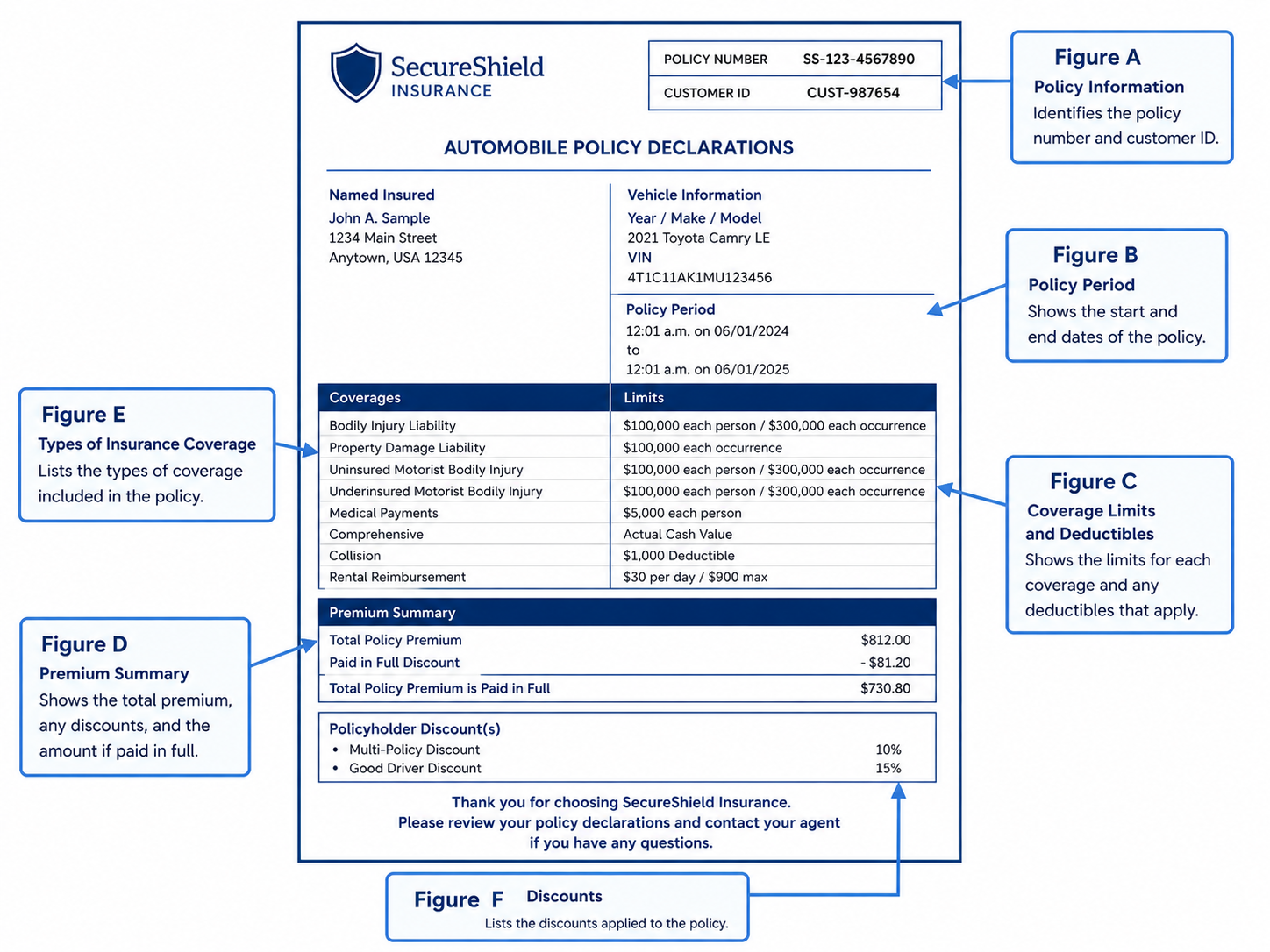
The sample declarations page in this article is divided into six labeled areas:
The insurance company, policyholder, address, policy number, vehicle, premium, and other information shown in the sample are fictional. Actual declarations pages differ by insurance company, but most contain similar categories of information.
The first portion of a declarations page ordinarily identifies the insurance policy and the people and vehicles it is intended to cover.
The named insured is the person or entity identified as the primary policyholder. In the sample declarations page, the named insured is John A. Sample.
This designation can be important because the complete policy may provide different rights and responsibilities to a named insured than it provides to a listed driver, passenger, family member, permissive driver, or other person who may qualify as an insured.
Check that the named insured's name and mailing address are correct. Contact the insurance company or agent after a move, marriage, divorce, legal name change, or another significant change that may affect the policy.
The policy number is the insurance company's identifying number for the contract. It is commonly requested when reporting a claim, contacting an adjuster, requesting policy documents, or confirming coverage.
Keep the policy number available, but avoid posting an actual policy number publicly.
The declarations page should accurately identify every insured vehicle. The sample includes the vehicle's:
Check the VIN carefully. A one-character error can create confusion about which vehicle was insured.
Also confirm that every vehicle you intend to insure is listed and accurately described. If you buy a new or replacement vehicle, promptly notify the insurer rather than assuming that the vehicle will automatically remain covered.
The policy period shows when the policy begins and ends.
The sample policy begins at 12:01 a.m. on June 1, 2024, and ends at 12:01 a.m. on June 1, 2025. Subject to the complete policy and applicable law, a covered event ordinarily must occur during the policy period.
After an accident, the relevant question is not simply whether a person currently has insurance. The question is whether applicable insurance was in effect at the time of the accident.
Automobile policies commonly begin and end at 12:01 a.m. on the dates shown. A policy ending at 12:01 a.m. on a particular date may expire at the beginning of that date rather than at the end of the day.
For example, a policy that ends at 12:01 a.m. on June 1 generally does not remain active throughout June 1 unless it has been renewed or replaced.
A lapse in automobile insurance may occur if a policy expires, is canceled, or is not renewed before the next policy takes effect. North Carolina generally requires continuous liability insurance for vehicles with valid North Carolina registrations. Even a short gap in coverage can have consequences. A future insurer may charge a higher premium, limit available discounts, or even decline to issue a policy based on the lapse. In addition, if a registered vehicle is uninsured, the North Carolina Division of Motor Vehicles may impose civil penalties and other registration-related consequences. To help avoid these issues, make sure any replacement policy becomes effective before your existing policy expires.
The North Carolina Department of Insurance explains that insurers notify the Division of Motor Vehicles when liability coverage is canceled or not renewed.
Confirm that renewal payments were made and that there is no gap between an expiring policy and a replacement policy. A vehicle owner should generally surrender the North Carolina license plate before canceling required liability insurance.
The coverages section identifies the categories of insurance included in the policy.
The sample declarations page lists:
Do not assume that every automobile policy contains every optional coverage. A coverage should ordinarily appear on the declarations page, coverage schedule, or applicable endorsement if it was purchased.
A coverage limit is the maximum amount the insurer may be required to pay under a particular coverage, subject to the complete policy terms and the facts of the claim.
The limits shown on the sample declarations page are:
Coverage limits do not necessarily establish how much a particular claim is worth. They establish the potential maximum available under the identified coverage. The claimant must still establish that the coverage applies and prove the amount of covered damages.
Bodily injury liability coverage may protect a covered driver when that person becomes legally responsible for causing bodily injury or death to someone else.
Depending on the facts and applicable law, recoverable damages may include:
The sample policy provides bodily injury liability limits of $100,000 per person and $300,000 per accident.
The $100,000 per-person limit is the potential maximum for covered bodily injury damages claimed by one person. The $300,000 per-accident limit is the potential maximum for all covered bodily injury claims arising from the same accident.
For example, if four people are injured in the same collision, each person's claim may be subject to the $100,000 individual limit, while the combined bodily injury payments remain subject to the $300,000 per-accident limit.
For North Carolina automobile policies issued or renewed on or after July 1, 2025, the minimum required liability limits are:
These requirements are commonly described as 50/100/50. They are minimum legal requirements, not necessarily adequate limits for every driver. A serious collision can produce damages that substantially exceed minimum coverage.
You can review the current requirements through the North Carolina Division of Motor Vehicles insurance requirements page, the North Carolina Department of Insurance summary of the July 1, 2025 changes, and N.C.G.S. § 20-279.21.
Property damage liability coverage may pay for covered damage that an insured driver negligently causes to someone else's property.
Examples may include damage to:
The sample declarations page provides $100,000 per accident in property damage liability coverage.
This coverage does not ordinarily pay for damage to the policyholder's own vehicle. Damage to the insured vehicle may instead fall under collision, comprehensive, uninsured motorist property damage, or another applicable coverage.
Uninsured motorist coverage, commonly called UM coverage, may protect an insured person who is legally entitled to recover damages from an at-fault driver who does not have applicable liability insurance.
UM coverage may also apply in certain qualifying hit-and-run cases, subject to North Carolina law and the requirements of the policy.
The sample declarations page provides uninsured motorist bodily injury limits of $100,000 per person and $300,000 per accident.
UM coverage is purchased under your own policy, but it addresses damages caused by another driver. It differs from bodily injury liability coverage, which protects a covered driver when that person causes injuries to someone else.
Potential UM coverage may exist under more than one insurance policy. Depending on the circumstances, an injured person's own policy, the policy covering the occupied vehicle, and policies issued to household family members may need to be reviewed.
Underinsured motorist coverage, commonly called UIM coverage, may apply when the at-fault driver has bodily injury liability insurance, but the available coverage is insufficient to compensate the injured person fully.
The sample declarations page provides UIM bodily injury limits of $100,000 per person and $300,000 per accident.
For North Carolina personal automobile policies issued or renewed on or after July 1, 2025, underinsured motorist coverage is required under the revised insurance statutes. The selected limits and the amount ultimately available may depend on the policy, the liability limits, the number of injured people, and other applicable insurance.
The calculation of available UIM benefits can be complicated. Relevant considerations may include:
For more information about automobile insurance and accident claims, review Galbavy Law's North Carolina car accident guide.
Medical Payments coverage, often called MedPay, is optional automobile insurance that may pay covered medical and funeral expenses resulting from an automobile accident.
The sample declarations page provides $5,000 in Medical Payments coverage for each person.
MedPay commonly does not require proof that another driver caused the accident. Subject to the policy, it may provide benefits when:
Covered expenses may include:
MedPay is separate from liability, UM, and UIM coverage. Payment of MedPay benefits ordinarily does not determine fault or establish the total value of a bodily injury claim.
At Galbavy Law, we generally recommend that drivers consider purchasing the highest Medical Payments (MedPay) coverage available under their automobile insurance policy. In many cases, the additional premium is relatively modest compared to the financial protection it may provide. Because MedPay may help pay covered medical expenses regardless of who caused the accident, it can be an extremely valuable benefit following both at-fault and not-at-fault collisions, subject to the terms and limits of the policy.
Collision coverage may pay for covered physical damage to the insured vehicle resulting from a collision.
Examples may include:
The sample declarations page describes collision coverage as actual cash value less a $1,000 deductible.
A deductible is the amount the policyholder is ordinarily responsible for paying toward a covered physical damage claim.
For example, if covered collision repairs cost $8,000, the policyholder would generally be responsible for the first $1,000 and the insurer would pay the remaining covered amount. The precise payment remains subject to the policy, repair estimate, vehicle value, and any other applicable provisions.
A higher deductible may reduce the insurance premium, but it increases the amount the policyholder must pay after a covered loss.
Actual cash value generally refers to the value of the vehicle immediately before the covered loss. It is not necessarily the original purchase price, the amount still owed on a vehicle loan, or the cost of purchasing a new replacement vehicle.
When a vehicle is declared a total loss, disputes may arise over:
The complete policy and applicable insurance rules should be reviewed when evaluating a total-loss offer.
Comprehensive coverage is also commonly called other than collision coverage. It generally applies to covered vehicle damage caused by events other than a collision.
Examples may include:
The sample declarations page identifies comprehensive coverage as providing actual cash value. It does not display a separate comprehensive deductible in the abbreviated coverage table.
Do not assume this means that no deductible applies. Review the complete declarations, coverage schedule, and policy forms to determine whether a deductible or another limitation applies.
Collision and comprehensive are separate coverages. A policy may have different deductibles for each.
Rental reimbursement coverage may help pay for temporary transportation when an insured vehicle cannot be driven or is being repaired because of a covered loss.
The sample declarations page provides:
Both limits matter. If a rental vehicle costs more than $30 per day, the policyholder may be responsible for the difference. If rental expenses reach the $900 total maximum, the policyholder may become responsible for additional rental charges.
This coverage generally applies only when the vehicle is unavailable because of a covered loss. It ordinarily does not provide a rental vehicle for routine maintenance, mechanical failure, or repairs unrelated to a covered claim.
The policy may also contain conditions concerning:
The premium is the amount charged for the insurance policy. It is not a coverage limit and does not indicate how much the insurer will pay after an accident.
The sample premium summary shows:
The paid-in-full discount reduces the amount charged when the policy premium is paid in full. It does not reduce the coverage limits shown elsewhere on the declarations page.
An actual declarations page may also identify:
If the premium differs from the amount expected, ask the agent or carrier for an explanation. Possible reasons may include changes to driver information, vehicle information, rating classifications, discounts, underwriting, prior insurance history, or the selected payment plan.
The sample declarations page displays:
Discount availability and eligibility differ among insurance companies. A discount may depend on:
Some discounts continue only while the qualifying condition remains in effect. For example, a multipolicy discount may end if a related homeowners, renters, or umbrella policy is moved to another insurer.
North Carolina also uses a Safe Driver Incentive Plan that may affect premiums based on qualifying convictions and at-fault accidents. More information is available from the North Carolina Department of Insurance Safe Driver Incentive Plan page.
An automobile insurance quote is an estimate of what an insurer may charge for a proposed combination of drivers, vehicles, limits, deductibles, optional coverages, and discounts.
A declarations page summarizes the policy that was actually issued.
The final premium or coverage may differ from an earlier quote after the insurer verifies information concerning:
After purchasing a policy, compare the issued declarations page with the coverage you requested. Contact the agent or carrier promptly if the issued policy does not match your understanding.
When comparing insurance quotes, make sure each company is pricing substantially the same coverage.
Compare:
A lower premium does not necessarily provide better value. The lower price may result from lower liability limits, reduced UM or UIM coverage, a higher deductible, less rental reimbursement, no MedPay, or the omission of another optional benefit.
The phrase “full coverage” does not identify a specific combination of policy limits and benefits. One person may use it to mean liability, collision, and comprehensive coverage. Another may assume it includes MedPay, rental reimbursement, roadside assistance, UM, UIM, or an umbrella policy.
Review each listed coverage rather than relying on the phrase “full coverage.”
The premium tells you what the policy costs. It does not tell you whether the limits are sufficient or whether important optional coverages were purchased.
A low premium may be accompanied by minimum liability limits, high deductibles, low rental limits, or no MedPay.
Bodily injury liability coverage generally protects an insured driver against claims made by other people. It ordinarily does not compensate the insured driver for that driver's own injuries.
An insured person's injuries may instead implicate MedPay, UM, UIM, health insurance, disability insurance, workers' compensation, or other available coverage.
A policy may provide a substantial per-person limit but a combined accident limit that must be divided among several injured people.
In the sample declarations page, each person's bodily injury claim is subject to the $100,000 per-person limit, while all injured people together are subject to the $300,000 per-accident limit.
Confirm that the vehicles, VINs, named insureds, and household drivers are accurately identified. Notify the insurer about significant changes involving:
Do not assume that a driver or vehicle is properly covered merely because an insurance premium is being paid.
Review the following information whenever a policy is issued or renewed:
Contact the insurer or agent promptly if information is missing or inaccurate. Keep a copy of any written request to change or correct the policy.
Many insurers offer multipolicy discounts when a customer purchases automobile insurance together with homeowners, renters, umbrella, boat, or other insurance.
Bundling may offer:
However, the discount should not be considered by itself. Compare the combined annual premium, limits, deductibles, exclusions, endorsements, and service provided under the entire insurance package.
The insurer offering the lowest automobile premium may charge more for homeowners or umbrella insurance. Another insurer may charge slightly more for automobile coverage but offer better total pricing or broader protection across all policies.
An umbrella policy may provide additional liability coverage above the limits of an underlying automobile or homeowners policy, subject to the umbrella policy's terms.
For example, an umbrella policy may provide additional protection when a serious automobile accident produces covered damages that exceed the automobile liability limits.
Umbrella policies commonly require specified underlying liability limits. Review:
Do not assume that an umbrella policy automatically includes uninsured or underinsured motorist protection. That depends on the policy and any available endorsements.
After a serious accident, the declarations page is often one of the first insurance documents reviewed by an attorney.
It may help identify:
The declarations page is only a starting point. A complete insurance investigation may require review of:
If you have been injured in a crash, Galbavy Law's North Carolina car accident lawyer page explains additional issues that may affect your claim. You may also review the firm's North Carolina personal injury page.
An injured person does not ordinarily receive the at-fault driver's complete declarations page at the scene of a collision. The insurance card usually identifies the carrier and policy number but may not show every available coverage limit.
Liability limits and other policy information may later be obtained through:
The available procedure depends on the claim, the insurer, whether a lawsuit has been filed, and applicable North Carolina law.
When reviewing or renewing automobile insurance, consider asking:
Ask the agent to provide written confirmation of any requested changes and review the revised declarations page after the change is processed.
Many people know how much they pay for automobile insurance but do not know how much coverage they purchased. Others assume they have “full coverage” without reviewing the specific limits, deductibles, and optional benefits listed on the policy.
Take a few minutes to locate your current declarations page. Confirm the named insureds, vehicles, policy dates, liability limits, UM and UIM protection, MedPay, physical damage coverage, rental reimbursement, and deductibles.
If you are comparing insurance companies, compare equivalent coverage rather than focusing only on the total premium. A cheaper policy may provide lower limits, higher deductibles, or fewer optional benefits.
If you have been injured in a North Carolina car accident, Galbavy Law can investigate potentially available liability, UM, UIM, MedPay, commercial, household, and umbrella insurance as part of evaluating your claim.
You can learn more about David Galbavy and the firm on the Galbavy Law About page.
This article is provided for general informational purposes and is not legal advice. Insurance coverage depends on the complete policy language, endorsements, applicable law, policy dates, and facts of the particular claim. The sample declarations page is fictional and is provided only for educational purposes.

Quick Summary: North Carolina court records allege that two drivers were participating in a high-speed...
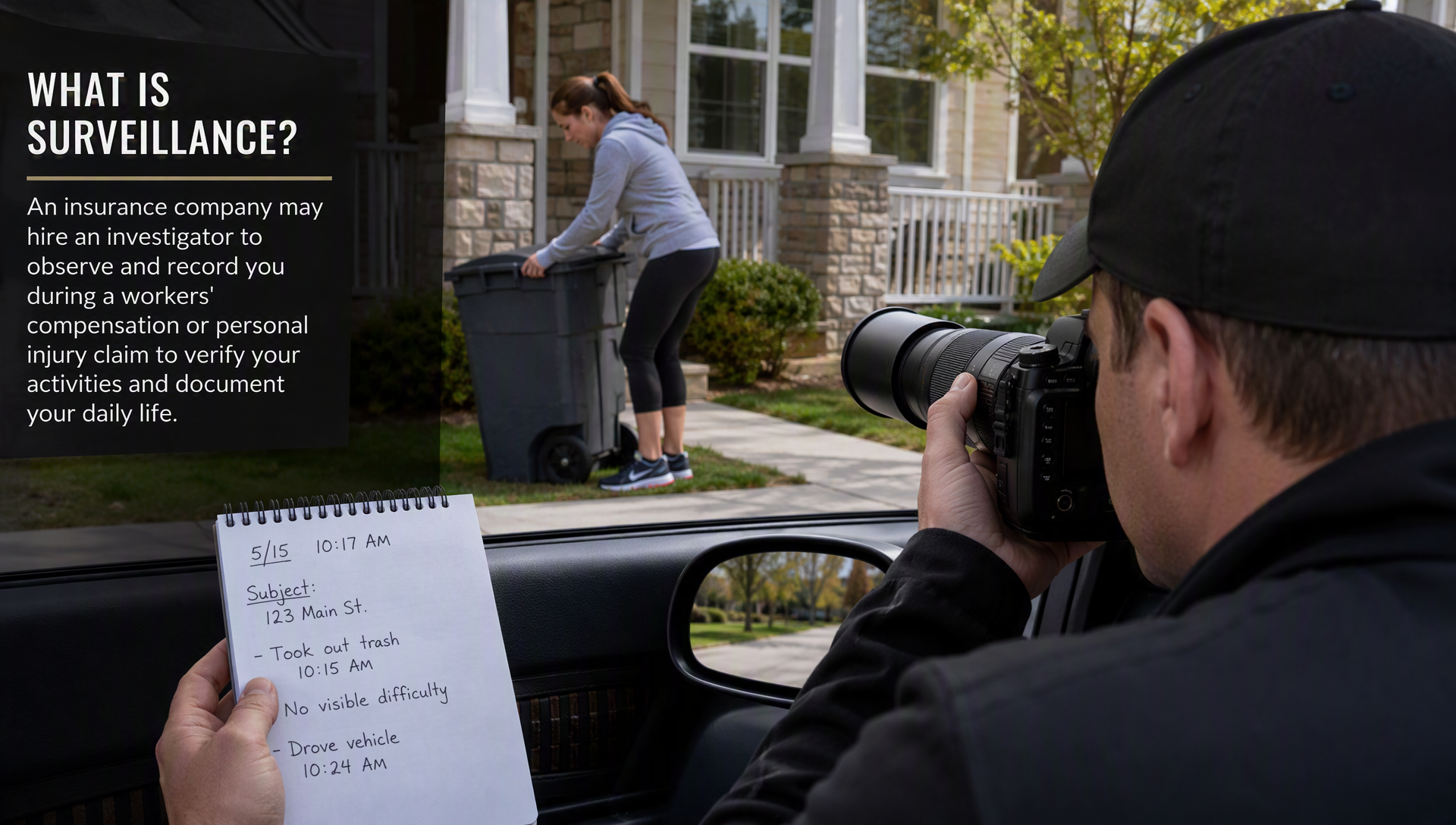
Quick Answer Yes, in the sense that an insurance company may hire an investigator to...

Quick Answer North Carolina requires drivers to maintain automobile liability insurance with minimum limits of...

1 Prior results do not guarantee similar outcomes in future cases because each case is unique and must be evaluated separately. The only way we can assist you is for you to call us about your case.
Protected by reCAPTCHA. Google Privacy Policy and Terms of Service apply.