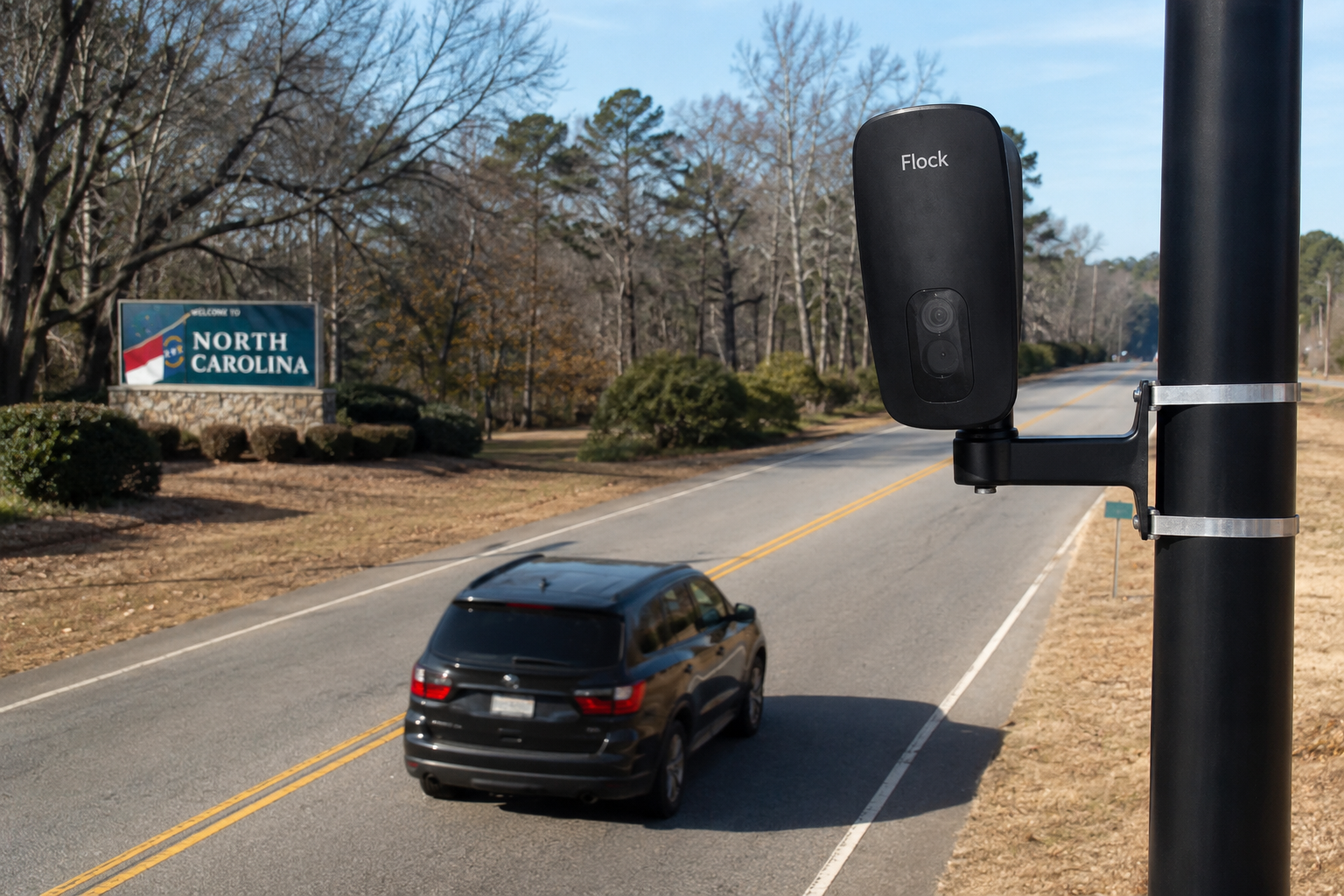
Quick Answer: Flock cameras and other automatic license plate readers are legal in North Carolina, and their use by law enforcement is expressly regulated by state law.
Flock cameras can help police locate stolen vehicles, find missing people, identify vehicles connected to serious crimes, and investigate hit-and-run accidents. They can also establish that a particular vehicle passed a particular location at a particular time.
But they are not ordinary video cameras, and they do not necessarily record a collision. They also create legitimate privacy concerns because a large network of cameras can potentially be searched to reconstruct where a vehicle has traveled.
North Carolina attempts to balance those competing interests by limiting how law enforcement may use ALPR data, generally restricting routine retention to 90 days, requiring agency policies and audits, prohibiting use of the data for ordinary traffic violations, and making captured plate data confidential rather than a public record.
At the same time, North Carolina significantly expanded statewide ALPR authority in 2026, making this an area of law and technology that will likely continue to receive public attention and additional regulation.
Flock Safety is a private technology company that produces automatic license plate reader systems, commonly called ALPRs.
“Flock camera” is therefore a brand name. “Automatic license plate reader” describes the technology.
North Carolina law defines an ALPR as a system of fixed or mobile automated high-speed cameras used with computer algorithms to convert images of license plates into computer-readable data.
Depending upon the system, a camera may associate a vehicle with information such as:
The important point is that a traditional Flock ALPR is primarily designed to identify and search for vehicles. It should not automatically be thought of as a conventional security camera continuously recording everything occurring within an intersection.
North Carolina law specifically identifies legitimate law enforcement purposes for ALPR technology.
Under N.C.G.S. § 20-183.30, permitted purposes include criminal investigations and arrests, apprehending individuals with outstanding felony warrants, locating missing or endangered people, and locating lost or stolen vehicles.
In practical terms, police may use the technology to help locate vehicles connected to:
The principal advantage is speed. Instead of relying entirely on a witness remembering a license plate or an officer happening to see a wanted vehicle, investigators may be able to search recent vehicle-location data.
There are situations where the public-safety benefit is substantial.
A missing child may be traveling in a known vehicle. A homicide suspect may flee across county lines. A stolen car may pass through several jurisdictions. A hit-and-run victim may remember only part of a license plate and the color of the vehicle.
An ALPR search may allow investigators to narrow the possibilities quickly and determine where a particular vehicle was observed.
North Carolina's statewide ALPR pilot has reportedly helped participating agencies recover stolen vehicles and investigate homicide and drug-trafficking cases. The program involved dozens of participating agencies, including the North Carolina State Highway Patrol and local departments. The General Assembly subsequently expanded the legal framework for ALPR deployment in state-maintained rights-of-way in 2026.
The privacy concern is not primarily that one roadside camera photographs one passing license plate.
The larger concern is what becomes possible when thousands of cameras are connected to searchable databases.
A single observation might establish only that a vehicle was on one road at one moment. A sufficiently large network, however, can potentially reveal a pattern of travel over time.
Critics argue that those patterns could reveal visits to:
Some privacy advocates describe this type of interconnected system as a step toward a surveillance state because technology can accomplish vehicle tracking on a scale that would have required enormous police resources only a generation ago.
Supporters respond that the technology does not eliminate legal restrictions, agency policies, auditing requirements, or accountability for improper searches, and that rapid vehicle identification can solve serious crimes and save lives.
North Carolina regulates law enforcement ALPR systems through Article 3D of Chapter 20, primarily N.C.G.S. §§ 20-183.30 through 20-183.33.

Under N.C.G.S. § 20-183.31, any state or local law enforcement agency using an ALPR system must adopt a written policy before operating the system.
The policy must address subjects including:
Agencies must also maintain records concerning system maintenance and calibration.
North Carolina law provides that ALPR data obtained under Article 3D may be obtained, accessed, preserved, or disclosed only for law enforcement purposes.
This is one of the most important statutory restrictions.
The same statute expressly provides that ALPR data obtained under Article 3D may not be used for enforcement of traffic violations.
In other words, the statutory law enforcement ALPR system is not designed to become an automated speeding-ticket network.
This does not mean North Carolina has no other camera systems related to traffic enforcement or traffic management. Those technologies are legally distinct from an ALPR.
Under N.C.G.S. § 20-183.32, captured plate data operated by or on behalf of a law enforcement agency generally may not be retained longer than 90 days.
There are exceptions, including qualifying law enforcement preservation requests and state or federal search warrants.
A proper preservation request can require particular plate data to be retained for an ongoing criminal or missing-person investigation.
Captured plate data under Article 3D is specifically classified as confidential and is not an ordinary public record.
The statute generally permits disclosure to qualifying criminal justice officials for legitimate law enforcement purposes pursuant to a written request.
The data may not be sold.
Under N.C.G.S. § 20-183.33, a person who obtains, accesses, preserves, or discloses ALPR data in a manner prohibited by Article 3D can be guilty of a Class 1 misdemeanor.
North Carolina initially authorized a pilot program allowing the State Bureau of Investigation to coordinate ALPR placement within certain NCDOT rights-of-way.
In 2026, the General Assembly enacted additional permanent authority through Session Law 2026-41 and new N.C.G.S. § 20-183.34.
The provision authorizes NCDOT to enter agreements with the State Bureau of Investigation concerning ALPR placement within state-owned or state-maintained rights-of-way, subject to statutory requirements.
The SBI may participate on its own behalf or serve administratively for participating federal, state, or local law enforcement agencies.
This is significant because North Carolina is no longer dealing solely with isolated local camera installations. State law now provides a framework capable of supporting a much broader network along state-maintained roads.
This distinction is particularly important after a car accident.
Many intersections in Charlotte and other North Carolina cities have cameras. Some are used for traffic management, incident monitoring, law enforcement, or other municipal purposes.
Those systems are not necessarily automatic license plate readers.
North Carolina's ALPR statute expressly excludes a traffic-control photographic system from the statutory definition of an automatic license plate reader.
Traditional intersection footage may be much more useful than ALPR data when the issue is determining exactly how a collision occurred because conventional video may actually show:
By comparison, a Flock camera may establish only that a particular vehicle passed a particular location at a particular time.
No.
This is a common misconception.
NCDOT expressly advises that its own traffic cameras do not record. They provide traffic monitoring, but there may be no historical video to obtain from the State.
Municipal systems can be different. A local government or police department may have access to recorded video from certain cameras, while other cameras may provide only live monitoring.
Retention periods can also differ substantially.
For that reason, a lawyer investigating a collision should not simply ask, “Was there a camera?”
The better questions are:
Unlike ALPR data, ordinary traffic or surveillance video may not be governed by the same 90-day ALPR retention framework.
The controlling rules depend on the camera and the agency maintaining it.
Some recorded systems overwrite footage after a relatively short period. A preservation request should therefore be sent as quickly as possible after a serious collision.
Obtaining the actual video may require different procedures depending upon the custodian. These can include an administrative request, a public-record process where applicable, cooperation through the investigating police department, a subpoena, or a court order.
The important point is that preservation and production are different issues. Even if a party cannot immediately obtain a copy, counsel should try to make sure potentially relevant footage is not destroyed while the proper legal process is being determined.
For a personal injury lawyer, Flock technology is most useful as an investigative tool rather than as a replacement for actual accident video.
This may be the clearest civil benefit.
Suppose a witness remembers that the fleeing vehicle was a black pickup truck and remembers only several characters from the plate.
Law enforcement may be able to compare that description with vehicles observed by nearby ALPR systems during the relevant period.
Identifying the driver can materially change the insurance claim.
Without an identified at-fault vehicle, an injured person may be forced to pursue an uninsured motorist claim under the victim's own insurance policy.
If the vehicle is identified, counsel can investigate the driver's liability policy, the owner's policy, potential commercial coverage, umbrella coverage, and other sources of recovery.
For more information, see Galbavy Law's North Carolina Auto Insurance Guide.
An ALPR record may establish that a vehicle was observed at a specific location at a specific time.
That can become important if a driver claims:
The ALPR record does not necessarily establish who was driving, and it does not independently establish fault. But it may corroborate or contradict other evidence.
Several camera hits can help establish a timeline.
A vehicle might appear at one camera shortly before the accident and another camera shortly afterward.
That information can help investigators identify the likely route and determine where to search for additional witnesses or video.
This may be one of the most overlooked benefits.
The Flock camera itself may not show the collision.
But suppose the data establishes that the suspected vehicle passed a particular gas station two minutes before the crash.
That tells counsel exactly where to look for:
ALPR information can therefore function as a roadmap to stronger evidence.
A Flock camera may prove that a vehicle was nearby.
A dash camera may show exactly how the collision happened.
Dash cameras have become relatively inexpensive and can provide direct evidence concerning:
Galbavy Law generally recommends that drivers consider installing a quality dash camera because the evidentiary value after a serious accident can substantially exceed the relatively modest cost of the equipment.
Generally, no.
Law enforcement ALPR data in North Carolina is confidential and is not an ordinary public record.
That is very different from asking a business to preserve its security video or requesting certain municipal records.
For a hit-and-run victim, the practical value of Flock often comes from police using the system during the criminal investigation to identify the suspect vehicle.
A civil attorney should not assume that a subpoena automatically gives access to an entire ALPR database. The availability of particular information depends on the statute, the custodian, the criminal investigation, and the legal process available in the particular case.
State law establishes the general legal framework, but local governments and law enforcement agencies still make important decisions about purchasing, accessing, placing, sharing, and supervising these systems.
Charlotte has used automatic license plate reader technology for years. CMPD currently has access to Flock information even though recent reporting indicates CMPD does not itself own or directly operate the Flock cameras it accesses.
That distinction demonstrates how modern ALPR networks operate. A police department may be able to search data produced by equipment belonging to another government agency or participating entity rather than owning every camera itself.
Charlotte also has many other cameras associated with intersections, traffic management, businesses, neighborhoods, and law enforcement.
Those cameras should not be confused with Flock cameras.
Gastonia has taken a particularly visible approach through its Real Time Crime Center.
The City has publicly reported that the system includes 21 Flock license plate readers, 22 Flock live cameras, and 144 downtown surveillance cameras.
That combination illustrates an important point: even within the same public-safety system, a Flock license plate reader and a conventional live-video camera are different technologies performing different functions.
Publicly compiled records from the Electronic Frontier Foundation's Atlas of Surveillance report that the Hickory Police Department operated 13 Flock ALPR cameras as of September 2025.
Because camera inventories and vendor relationships can change, anyone investigating a specific collision in Hickory should confirm the current system directly with the Hickory Police Department rather than assume that a historical camera remains in the same location.
Asheville provides one of the clearest examples of public transparency surrounding ALPR technology.
The Asheville Police Department publicly states that it uses two systems:
Asheville also maintains public-facing dashboards concerning ALPR use, statistics, and policies.
This type of transparency gives residents more information about how frequently the technology is used and what rules govern access.
The strongest argument for auditing and access controls may be that North Carolina has already seen allegations of improper use.
In July 2026, a Charlotte-Mecklenburg police officer was arrested after the State Bureau of Investigation alleged that he improperly searched Flock and the State's CJLEADS database.
According to court documents reported by multiple Charlotte news organizations, the officer allegedly identified a vehicle as belonging to an undercover law enforcement officer and provided that information to the target of an active drug investigation.
The officer was charged with a misdemeanor related to improper computer access. The allegations remain pending and are not proof of guilt.
Only days later, a Mooresville police officer was accused of using the Flock system repeatedly for personal purposes.
Police alleged that the officer searched the system approximately 31 times to track her boyfriend's former wife. The alleged activity was discovered through an audit, and the officer was charged with misdemeanor computer access.
Again, the criminal allegation does not establish guilt.
But the cases illustrate the underlying privacy issue. Even a useful law enforcement tool can be abused when an authorized user conducts searches for a personal or otherwise unauthorized purpose.
The controversy is national, not limited to North Carolina.
In August 2026, Flock announced additional safeguards following reports of unauthorized searches and increasing public criticism.
The company announced plans to require stronger auditing tools, more consistent use of case numbers associated with searches, additional controls over interagency sharing, and a reduction in the standard Flock platform retention period from 30 days to seven days beginning in 2027 unless information is preserved for an investigation.
Those private-company retention changes are separate from North Carolina's statutory maximum of 90 days. A shorter company default does not eliminate the State's legal requirements or exceptions.
The changes demonstrate how quickly this area is evolving.
This concern becomes more complicated when cameras are positioned near neighborhoods, driveways, parking lots, or private property.
An ALPR aimed at a public roadway will inevitably capture vehicles near homes and businesses. Depending on the camera's field of view and the particular technology being used, the image may also contain portions of driveways, yards, buildings, or people near the vehicle.
That does not mean North Carolina's ALPR statute gives law enforcement unlimited authority to conduct surveillance of private property.
There is an important difference between a camera incidentally capturing something visible from a public roadway and intentionally positioning or using technology to conduct sustained surveillance of constitutionally protected private areas.
The traditional Flock ALPR statute is directed toward vehicle and license-plate information. Broader video surveillance, intentional observation of the curtilage of a home, and other forms of technologically assisted surveillance may raise separate Fourth Amendment and North Carolina constitutional questions.
As ALPR systems become more capable and are combined with other camera technologies, this distinction is likely to receive increasing attention.
Growing opposition has also resulted in vandalism.
In July 2026, police in Rutherfordton, North Carolina reported that a Flock camera had been damaged. Similar vandalism was reported elsewhere in the Carolinas.
Whatever someone's opinion of government surveillance, intentionally damaging a camera is not a lawful method of challenging the policy.
Depending upon the ownership of the equipment, how it is installed, the amount of damage, and the particular conduct, vandalism may potentially implicate North Carolina criminal statutes governing willful damage to personal property or real property, in addition to other offenses that may apply to the particular facts.
For example, N.C.G.S. § 14-160 generally criminalizes willful and wanton injury to another person's personal property, with the offense level increasing when the damage exceeds the statutory threshold.
Legal objections to Flock cameras are better pursued through courts, legislation, municipal government, public-record advocacy, and public debate rather than destroying equipment.
From a personal injury perspective, I see substantial value in technology that can help identify a hit-and-run driver or establish where a vehicle was immediately before or after a serious collision.
If law enforcement can identify an at-fault vehicle that otherwise would have disappeared, the injured person may be able to pursue the responsible driver's liability insurance instead of relying solely on uninsured motorist coverage.
At the same time, I understand why a large searchable database containing the movements of ordinary drivers creates legitimate privacy concerns.
The recent allegations involving officers in Charlotte and Mooresville demonstrate that misuse is not merely theoretical. A system designed for legitimate criminal investigations can also be improperly searched for personal reasons or to disclose information that should remain confidential.
That does not necessarily mean the technology should be prohibited. It does mean that access controls, case-number requirements, audit trails, retention limits, meaningful penalties, transparency, and appropriate judicial oversight deserve serious attention.
The debate is therefore more complicated than whether Flock cameras are simply “good” or “bad.”
The technology can solve crimes, find missing people, identify hit-and-run vehicles, and provide important investigative leads. The same technology can also create a detailed record of ordinary citizens' movements if its use is not properly limited.
This area is changing quickly.
North Carolina expanded the statewide legal framework in 2026. At the same time, communities around the country are reconsidering Flock contracts, privacy advocates are pushing for greater restrictions, law enforcement agencies are confronting allegations of improper searches, and Flock itself is introducing additional auditing and retention safeguards.
I expect the legal debate to increasingly focus on narrower questions:
Those questions will likely become more important as the number and capabilities of cameras continue to grow.
Flock cameras are legal in North Carolina, but their use by law enforcement is not unrestricted.
State law requires written agency policies, limits the use of ALPR data to law enforcement purposes, prohibits its use for ordinary traffic enforcement, generally limits routine retention to 90 days, makes captured plate data confidential, and provides criminal penalties for improper access or disclosure.
North Carolina also expanded statewide ALPR authority in 2026, making these systems likely to become even more common along state-maintained roads.
For accident victims, ALPR technology can be particularly valuable in hit-and-run investigations, identifying vehicles, establishing timelines, and directing investigators toward other cameras. But Flock data should not be confused with conventional intersection video. A traditional traffic or surveillance camera may provide far better evidence of how an accident actually happened, and that footage should be identified and preserved quickly before it is overwritten.
The technology presents real benefits and real privacy concerns. As both become more apparent, North Carolina will likely continue refining the balance between effective law enforcement and appropriate limits on government surveillance.
For more information about investigating a serious collision, visit Galbavy Law's North Carolina Car Accident Lawyer page or contact Galbavy Law.
This article is provided for general informational purposes and is not legal advice. ALPR technology, municipal camera systems, agency policies, vendor practices, and applicable law can change. The availability and admissibility of particular camera evidence depend upon the facts and legal circumstances of each case.
As Flocks cameras are a hot topic, we expect ongoing changes to policy. Therefore, some of the information in this article may become outdated. We will do our best to update the post with new information and make a note of our most recent edits.
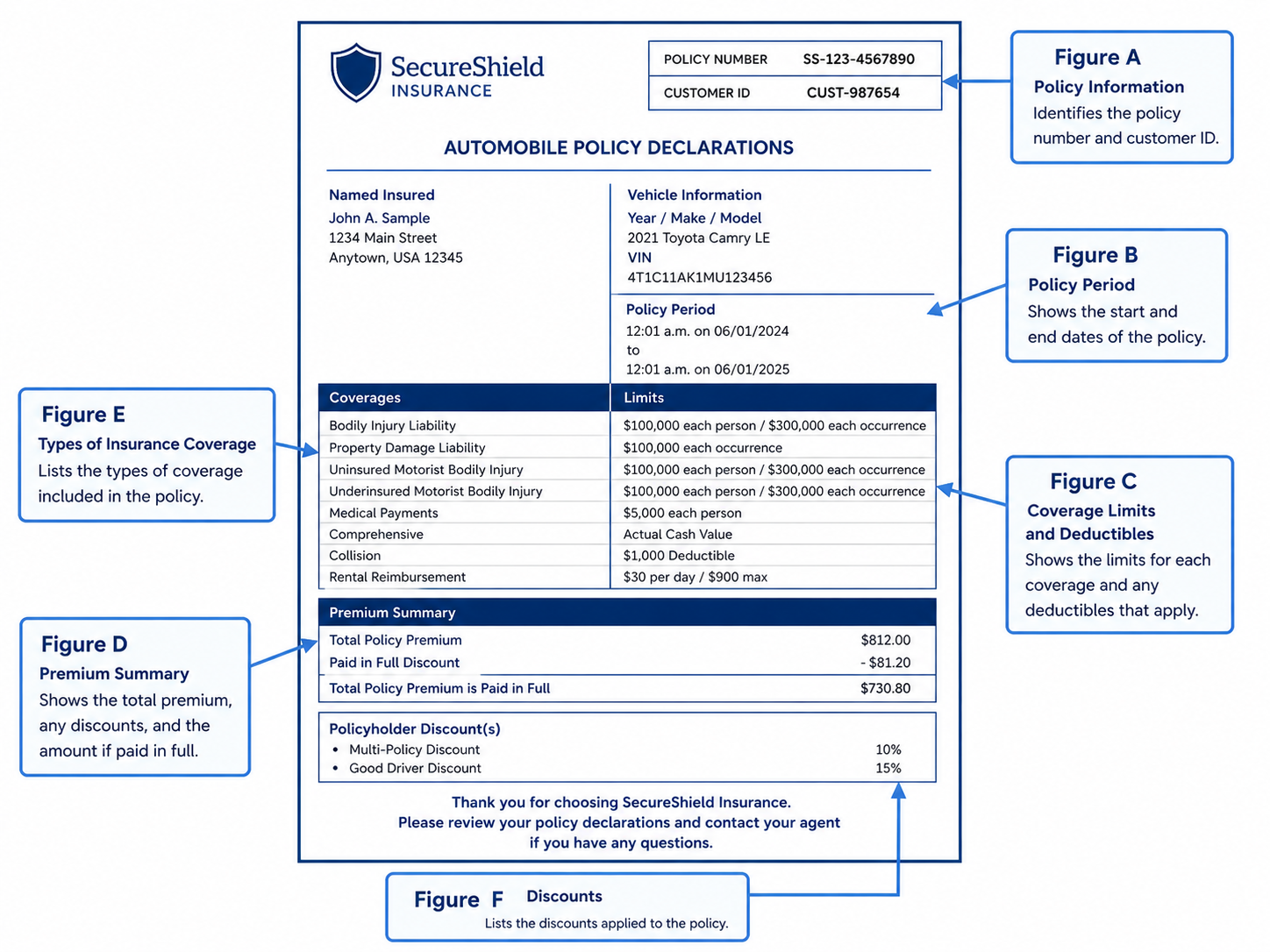
Quick Answer: An automobile insurance declarations page is a summary of the policy that was...

Quick Answer North Carolina requires drivers to maintain automobile liability insurance with minimum limits of...
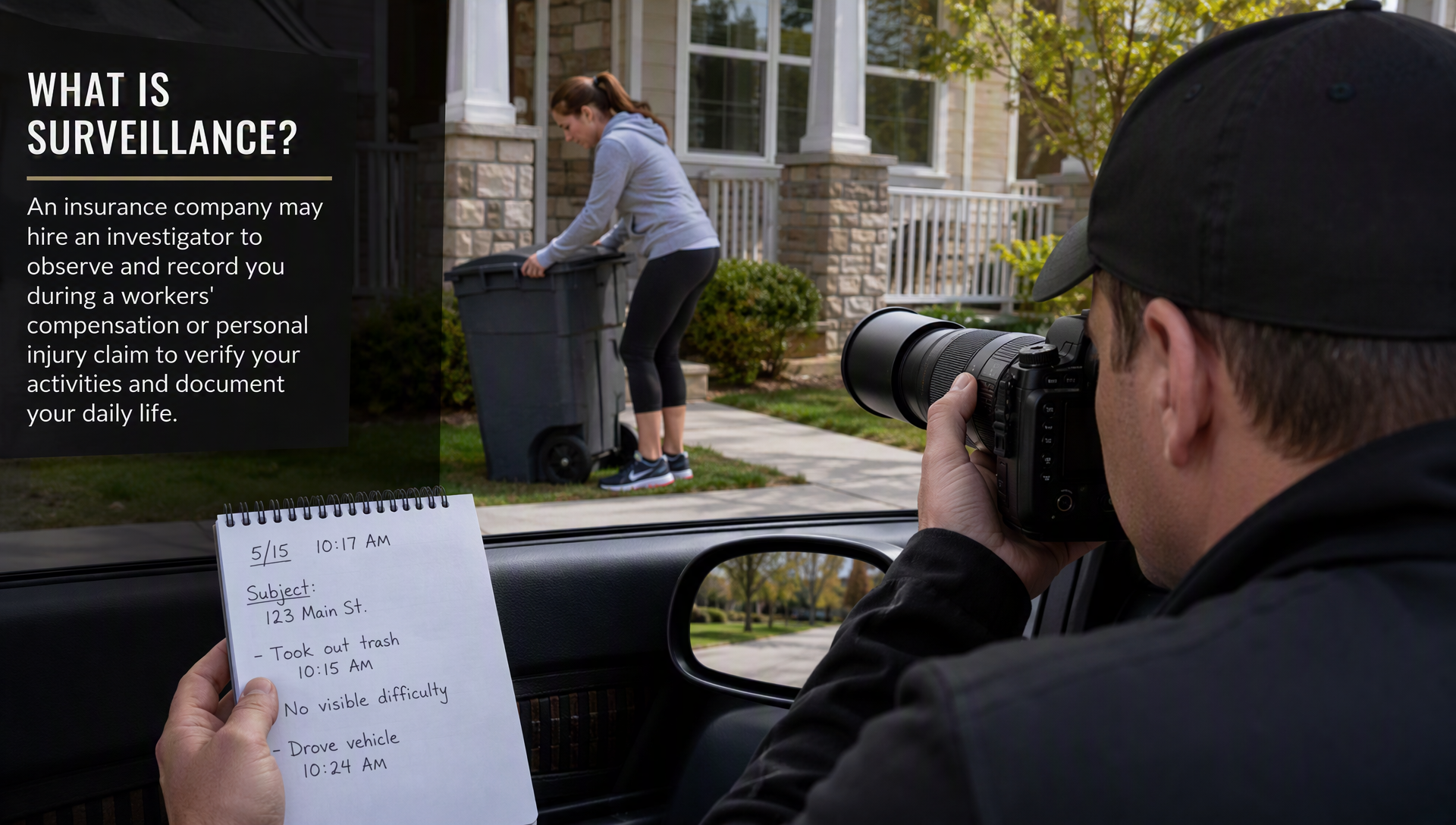
Quick Answer Yes, in the sense that an insurance company may hire an investigator to...

1 Prior results do not guarantee similar outcomes in future cases because each case is unique and must be evaluated separately. The only way we can assist you is for you to call us about your case.
Protected by reCAPTCHA. Google Privacy Policy and Terms of Service apply.