Premises liability applies when someone is injured because a property in Gastonia was not kept reasonably safe.
Under North Carolina law, property owners and managers can be held responsible when preventable hazards cause harm to customers, tenants, guests, or others lawfully on the property. These cases focus on unsafe conditions, not careless behavior by the injured person.
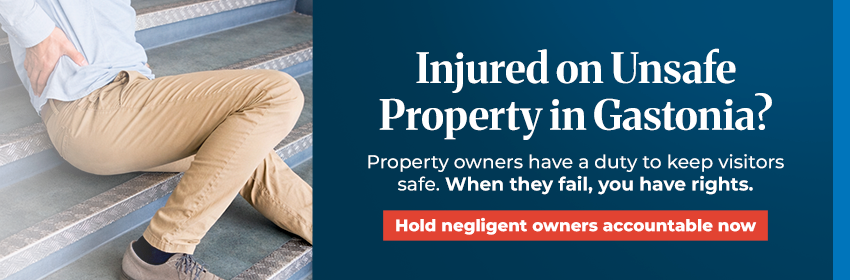
In Gastonia, premises liability injuries often happen in everyday places people trust to be safe. Slip and falls in stores along Franklin Boulevard, broken steps in apartment complexes, uneven pavement in parking lots near I-85 exits, and poorly lit walkways all create real risks when maintenance is ignored or delayed.
At Galbavy Law, we represent people who were hurt because a property owner failed to take reasonable steps to protect visitors.
We know the local properties, the courts, and the tactics insurers use to deny responsibility. When an unsafe condition leads to injury, accountability matters.
Premises liability injuries in Gastonia most often happen in everyday places where people expect safe conditions.
These cases are tied to locations with heavy foot traffic, shared access areas, and ongoing maintenance responsibilities, especially along major corridors and residential areas throughout the city.
Retail stores, restaurants, and shopping centers along Franklin Boulevard see constant customer traffic. When maintenance falls behind, hazards can quickly put visitors at risk.
Apartment complexes throughout Gastonia must maintain common areas used by residents and guests. Injuries often occur when repairs are delayed or ignored.
Parking areas and sidewalks are common sites for premises injuries due to uneven surfaces and limited visibility. These risks increase in high-traffic areas near businesses and residential complexes.
Areas near I-85 see increased foot traffic from travelers and commuters. Public-facing properties in these zones often face higher safety demands.
A property condition is considered unreasonably dangerous when it creates a risk of injury that a property owner knew about or should have discovered and fixed.
Courts focus on how foreseeable the hazard was, how visible it was, and whether a reasonable person could have avoided it under normal conditions.
Some hazards are dangerous because they are not something a visitor would anticipate encountering on the property.
When a hazard blends into its surroundings, it becomes harder to detect and easier to overlook.
A hazard does not have to exist for a long time to be dangerous. Short-term conditions can still lead to injuries when no action is taken.
Yes, you can still sue if the property owner’s employees caused the spill, neglected proper inspection practices, or overlooked a known risk; they may be held responsible. The main factor is whether the owner should have discovered and addressed the hazard, rather than just how long it had been there.
A property owner becomes legally responsible when they control the property, know or should have known about a dangerous condition, and fail to take reasonable steps to fix it or warn visitors.
In Gastonia, this applies to businesses, landlords, and property managers whose inaction allows preventable hazards to cause injury.
Responsibility is tied to who had control over the area where the injury occurred. Property owners, management companies, or businesses may all owe a duty of care depending on who was responsible for maintenance and safety at the time.
Actual notice means the owner knew about the hazard, while constructive notice means the condition existed long enough that it should have been discovered. Many premises cases turn on whether reasonable inspections would have revealed the danger.
How quickly a property owner responds to a hazard can determine liability. Delays in fixing known issues or failing to act within a reasonable time can turn a minor problem into a serious legal responsibility.
A duty of care depends on why you were on the property and who controlled the area where the injury occurred.
In Gastonia, property owners and managers generally owe the highest duty to customers, tenants, and invited visitors, while obligations may differ for others depending on the circumstances.
Property owners owe a duty to keep the premises reasonably safe for people invited onto the property. This includes customers in stores, guests in common areas, and anyone lawfully visiting for business or social reasons.
Landlords and property managers may owe duties to renters for unsafe conditions in common areas or for hazards they are responsible for repairing. Responsibility often depends on lease terms and who controlled the area where the injury occurred.
Contractors and service workers may still be owed a duty of care while performing authorized work. Even when hazards are related to ongoing work, property owners may be responsible if they fail to address known dangers.
Not always. While property owners owe fewer duties to trespassers, there are exceptions, primarily when dangerous conditions are known or when children are involved. Each situation depends on the specific facts.
Premises liability cases are often challenged by arguments that the injured person should have been more careful.
In North Carolina, however, the key issue is whether an unsafe property condition existed and whether the owner failed to address it. Owner responsibility can change the outcome, even when insurers attempt to shift blame.
Some incidents occur without any dangerous conditions on the property. For example, a simple misstep on a dry, well-lit floor inside a Gastonia store, with no defects or hazards present, may not support a premises liability claim.
Premises liability applies when an injury is caused by a condition that was hidden, unexpected, or left unaddressed. An example might involve slipping on an unmarked wet floor at a business along Franklin Boulevard, where no warning signs were posted.
When a property owner knew or should have known about a hazard and failed to act, responsibility shifts away from the visitor. For instance, uneven pavement in a poorly lit parking lot near an I-85 access point may place liability on the owner rather than the injured person.
Premises liability cases are proven through careful evidence collection that shows where the hazard existed, how long it was present, and how it caused injury.
In Gastonia, our approach focuses on the specific property involved, preserving time-sensitive records, and building a clear connection between unsafe conditions and the harm suffered.
We start by evaluating the exact area where the injury occurred. This includes walkways, entrances, stairwells, or parking areas to understand how the hazard fits into the property’s layout and how visitors are expected to move through the space.
How long a dangerous condition was present is critical in these cases. We look for evidence showing whether the hazard existed long enough that the property owner should have discovered and addressed it through reasonable inspections.
Surveillance footage, cleaning logs, and maintenance records can disappear quickly. We take early steps to preserve this information before it is overwritten or lost, especially at commercial properties and apartment complexes in Gastonia.
Medical records and incident documentation are used to link the unsafe condition to the injury. This step helps counter arguments that injuries came from unrelated causes or preexisting conditions.
We prepare every case as if it will be presented in Gaston County Superior Court. This approach strengthens negotiations and ensures readiness if litigation becomes necessary.
Property injury claims are often challenged immediately because insurers and property owners work to limit responsibility before evidence is thoroughly reviewed.
In Gastonia, these disputes usually focus on notice, fault, and documentation, rather than on what actually caused the injury.
Property owners often claim they were unaware of any dangerous condition. This argument is used early to avoid responsibility before inspections or maintenance practices are examined.
Insurers frequently argue that the injured person caused their own accident. This tactic is especially common in slip and fall cases.
Important records sometimes disappear shortly after an injury. Missing documentation can be used to cast doubt on how the accident occurred.

Early settlement offers are often made before the full extent of injuries is known. These offers typically undervalue long-term medical needs and losses.
After a premises injury, property owners and insurers often focus on limiting responsibility instead of addressing unsafe conditions.
In Gastonia, these cases are frequently disputed early through arguments about notice, fault, and missing evidence. Understanding these tactics helps injured visitors protect their rights before key information disappears.
A common defense is that the dangerous condition appeared moments before the injury and could not have been prevented. This argument is often used in busy stores, restaurants, and parking areas along Franklin Boulevard, where owners claim there was no time to act.
Insurers regularly try to shift attention away from the property and onto the injured visitor. In Gastonia cases, this may involve suggesting distraction, improper footwear, or simple carelessness.
North Carolina's strict contributory negligence rules can lead to serious consequences if not challenged. The state’s law specifies the burden of proof regarding contributory negligence.
Time often works in the property owner’s favor. Surveillance footage, cleaning logs, and inspection records can be lost or overwritten if not preserved quickly.
This is especially common in apartment complexes, shopping centers, and shared access areas near I-85.
Property owners or insurers may request statements shortly after the injury, when the injured person is still focused on medical care. Casual comments can later be reframed as admissions of fault.
Another tactic is pushing for a quick resolution before injuries are fully understood. Early discussions may happen before follow-up care reveals long-term or permanent effects.
Recognizing these strategies explains why premises liability claims are often contested from the start. Acting early helps keep the focus where it belongs: on unsafe property conditions and the responsibility to prevent them.
After a premises liability injury in Gastonia, recovery is focused on the real losses caused by unsafe property conditions.
North Carolina law allows injured people to seek compensation for medical care, lost income, physical pain, and lasting limitations that affect daily life and future stability.
Premises injuries often require more than emergency treatment. Ongoing care, follow-up visits, rehabilitation, and future medical needs may all be part of a claim when the injury has lasting effects.
Time away from work can create immediate financial strain. If injuries limit your ability to return to the same job or work at the same level, future earning losses may also be considered.
Beyond financial losses, injuries can interfere with everyday activities. Pain, reduced mobility, and difficulty performing routine tasks are common consequences that may be compensable.
Some premises injuries result in permanent limitations. Long-term impairments can affect independence, quality of life, and the ability to work, increasing the overall impact of the injury.
If you were injured on unsafe property in Gastonia, the next step is not about rushing into a lawsuit.
It is about getting clarity. When something feels off about how an injury happened, a calm review can help you understand whether a property owner failed to meet their responsibility and what options are available.
Many people are unsure whether their injury “counts” as a legal issue. If a hazard was unexpected, poorly maintained, or ignored, that uncertainty is often a sign that it is worth getting answers before evidence disappears.
You do not need everything to start. Basic details about where the injury happened, photos of the area if available, medical treatment received, and any incident report can help assess whether unsafe conditions played a role.
Reports from agencies like the Gaston County Sheriff’s Office can help document what happened, even when a premises injury is not a criminal matter.
When you contact Galbavy Law, you speak with a local legal team that listens first. We review what happened, explain how premises liability works in Gastonia, and walk through your options clearly, without pressure.

A premises liability case involves an injury caused by an unsafe property condition. The focus is on whether the property owner knew or should have known about the hazard and failed to fix it. Common examples include slips and falls, broken stairs, and poorly maintained walkways.
A warning sign does not automatically remove responsibility. Property owners must still take reasonable steps to fix dangerous conditions. Signs may reduce risk, but they do not excuse ignoring known hazards.
There is no specific time limit regarding how long a hazard remains relevant if it has existed long enough for a property owner to discover and address it. Courts consider inspection practices and the particular circumstances involved.
Yes, in many situations, tenants can sue property owners. Landlords may be responsible for unsafe conditions in common areas or for repairs they were obligated to make. Liability depends on control and notice.
Fixing a hazard after an injury does not erase responsibility. Post-injury repairs support a claim that the condition was dangerous. The key issue is the condition at the time of the injury.
Businesses may be responsible for injuries in parking lots they own or control. Uneven pavement, poor lighting, and missing markings can create liability. Responsibility depends on who maintains the area.
A lack of witnesses does not prevent a valid claim. Medical records, photos, incident reports, and surveillance footage can still establish what happened. Many premises cases move forward without eyewitnesses.
North Carolina follows strict contributory negligence rules. If an injured person is found even slightly at fault, recovery may be barred. This makes evidence and legal strategy especially important.
Some premises cases resolve in a few months, while others take longer. The timeline depends on injury severity, evidence availability, and whether the case goes to court. Early investigation often shortens the process.
A premises liability lawyer investigates the property, preserves evidence, and handles communication with insurers. At Galbavy Law, our team works to prove unsafe conditions caused the injury and pursue fair compensation on your behalf.
Local knowledge matters in premises liability cases because success often depends on understanding the specific property, not just the law.
Familiarity with Gastonia’s businesses, property layouts, and court procedures allows hazards to be identified faster and arguments to be built around real conditions, not generic assumptions.
Premises cases turn on where and how an injury happened. Knowing the layout of shopping centers, apartment complexes, and high-traffic areas in Gastonia helps identify maintenance gaps, poor design, and recurring safety issues that outsiders often miss.
Local court procedures and expectations shape how premises cases move forward. Experience in Gaston County helps avoid delays, anticipate defenses, and present evidence in a way that aligns with how these cases are actually handled.
Being local means quick access to the property itself. On-site investigation can make the difference when conditions change, repairs are made, or evidence disappears.
When unsafe property causes injury, timing and local insight matter. Contacting an experienced premises liability lawyer early helps preserve evidence and protect your options.
Galbavy Law brings hands-on Gastonia experience and direct communication from start to finish. Call 704-412-4466 or complete our online contact form today to schedule a free consultation and get clear answers about your case.

1 Prior results do not guarantee similar outcomes in future cases because each case is unique and must be evaluated separately. The only way we can assist you is for you to call us about your case.
Protected by reCAPTCHA. Google Privacy Policy and Terms of Service apply.