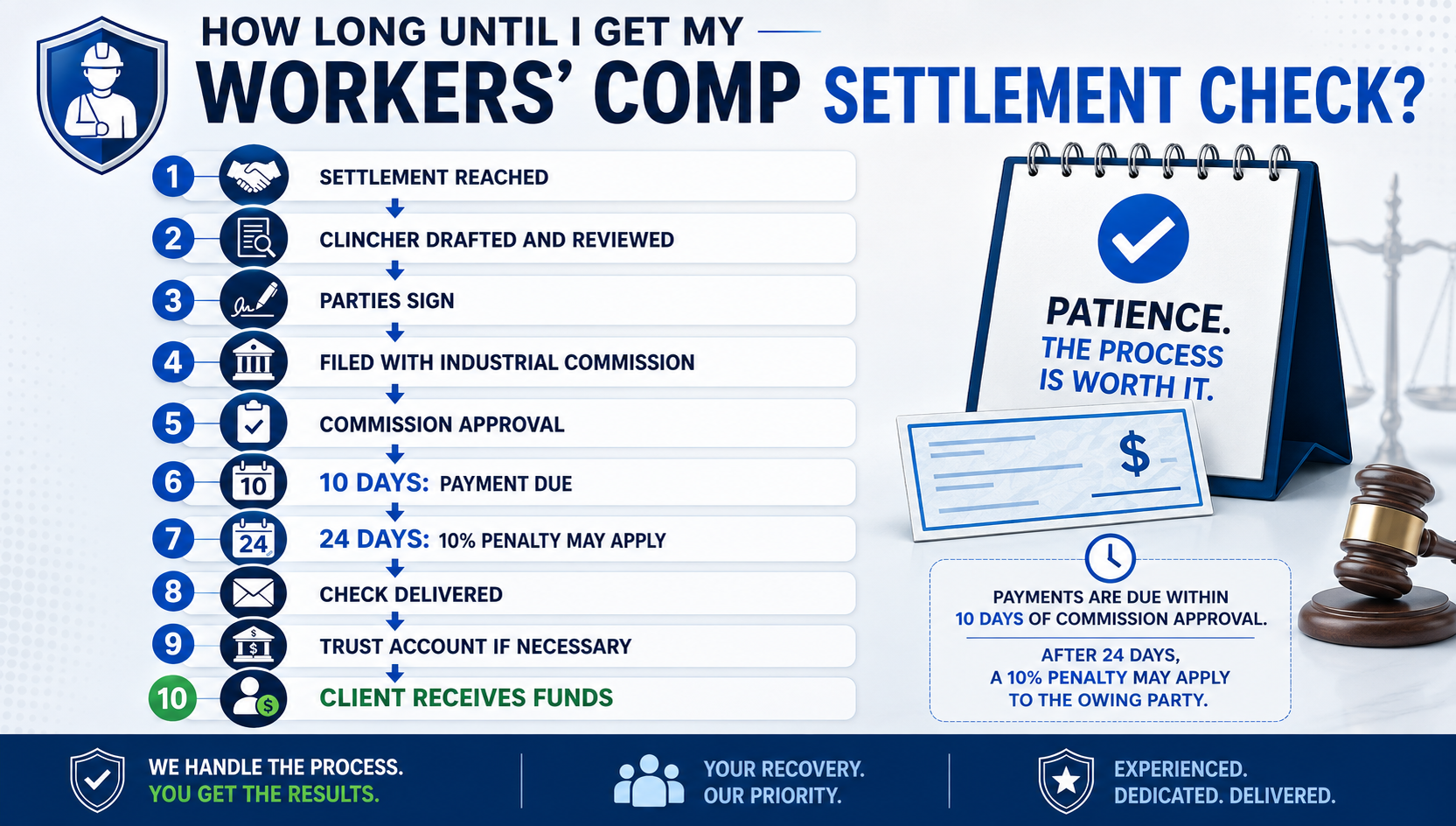
Quick Answer: A North Carolina workers’ compensation settlement commonly takes several weeks from the day the parties agree on a settlement until the injured worker actually has the money available. Four to six weeks is a reasonable general estimate for many straightforward cases, but it is not a guarantee.
The timeline includes drafting and negotiating the final settlement agreement, obtaining signatures, submitting the agreement to the North Carolina Industrial Commission, receiving Commission approval, issuing and mailing the settlement check, and sometimes depositing the proceeds into the attorney’s trust account before they can be distributed.
One of the most important points is that the insurance company’s payment deadline does not begin on the day you agree to settle. The statutory payment period generally begins after the Industrial Commission approves the final Compromise Settlement Agreement and the defendants receive notice of that approval.
A workers’ compensation case may settle at mediation or through informal negotiations between the attorneys.
Reaching an agreement on the settlement amount is an important step, but it is not the end of the process.
The parties generally must prepare a much more detailed written agreement formally known as a Compromise Settlement Agreement. Workers’ compensation attorneys commonly refer to this agreement as a clincher.
Under N.C. Gen. Stat. § 97-17, a workers’ compensation compromise settlement must be filed with and approved by the North Carolina Industrial Commission.
In most cases, the defense attorney prepares the first draft of the final Compromise Settlement Agreement.
In my experience, a first draft often arrives within approximately three to seven days after settlement. That is a practical estimate, not a statutory deadline.
Sometimes the draft takes considerably longer.
Possible reasons include:
Unfortunately, there is usually no simple method for forcing opposing counsel to produce the first draft within a few days.
Once the defense attorney circulates the draft, the injured worker’s attorney should review it carefully.
A clincher agreement does much more than state the settlement amount. It often includes provisions for:
The attorneys may disagree about some of this language.
For example, defense counsel may include detailed references to prior medical treatment, an unrelated failed drug test, unfavorable medical history, or other information that plaintiff’s counsel believes is unnecessary or misleading.
There may also be disagreements about medical allocations, disputed medical bills, Medicare language, the factual description of the claim, or other terms.
Most of these disagreements can be resolved. However, every additional issue creates the possibility of more delay.
Once the attorneys agree on the final language, the agreement is circulated for signatures.
This is the time to ask your attorney any remaining questions.
Do not sign a Compromise Settlement Agreement simply because you are anxious to receive the money.
You should understand:
Once the agreement is signed and approved, changing the material terms becomes extremely difficult.
Under N.C. Gen. Stat. § 97-17, an approved settlement is generally final, subject to limited grounds such as fraud, misrepresentation, undue influence, or mutual mistake.
After all parties and attorneys sign the agreement, the defendants generally submit the settlement package electronically to the North Carolina Industrial Commission.
The agreement must satisfy the requirements of N.C. Gen. Stat. § 97-17 and the Industrial Commission’s rules governing Compromise Settlement Agreements.
The settlement package generally includes relevant medical, vocational, and rehabilitation reports known to exist. The settlement must also address known medical expenses related to the work injury, including disputed medical expenses, unless the employer agrees to pay all qualifying medical expenses through the settlement date.
This requirement is one reason missing records or unresolved medical bills may delay submission or approval.
The Industrial Commission must approve the Compromise Settlement Agreement before the settlement is final.
The Commission reviews the agreement to determine whether it complies with North Carolina law and whether it is fair and just to the parties.
The Commission’s published procedural guidance historically estimated approximately five to seven days to review a properly submitted compromise settlement, with additional time when further information is required.
In my experience over the last several years, straightforward settlements involving represented parties are often approved within a few business days.
That is not guaranteed. Missing medical records, incomplete documents, unresolved medical expenses, Medicare issues, unpaid Commission expenses, or questions from the Commission may extend the process.
The Industrial Commission’s approval order is extremely important because it starts the settlement-payment process.
The Commission explains that once the defendants receive notice of the Order approving the Compromise Settlement Agreement, the defendants must issue the settlement payment within 10 days.
That is the actual payment deadline.
However, there is an additional 14-day period before the statutory late-payment penalty generally applies.
The practical timeline is therefore:
This distinction is important.
You will sometimes hear workers’ compensation attorneys refer to a “24-day deadline.” Technically, payment is due within 10 days. The 24-day date is important because that is generally when failure to timely tender payment exposes the carrier to the additional 10% penalty.
You can review the statutory penalty provision at N.C. Gen. Stat. § 97-18(g).

Another common misunderstanding is that the injured worker or attorney must physically receive the check within 24 days.
That is not necessarily true.
In Morrison v. Public Service Company of North Carolina, Inc., 182 N.C. App. 707, 643 S.E.2d 58 (2007), the North Carolina Court of Appeals explained that the relevant question is whether payment was timely tendered.
A properly issued payment may be timely tendered when it is properly addressed and placed with the United States Postal Service or another qualifying delivery service.
Therefore, a carrier may satisfy the payment requirement even though the check does not physically arrive at the attorney’s office until several days later.
This occasionally happens.
Settlement checks are still frequently sent through ordinary mail. A check may be delayed, misdirected, lost, or in rare cases damaged or destroyed during delivery.
If the carrier properly issued the correct check and timely placed it in the mail, the carrier may have timely tendered payment even though the check was never received.
In that situation, plaintiff’s counsel generally contacts defense counsel or the adjuster, confirms that the original check was issued, requests a stop-payment order when appropriate, and asks that a replacement check be issued.
The fact that the replacement check is issued after the 24-day period does not necessarily create a 10% penalty if the carrier can establish that the original, correct payment was timely tendered.
The replacement should still be issued within a reasonable period after the problem is identified.
This is very different from a situation where the carrier never issued the payment in the first place.
A different issue arises when the carrier sends a check that is materially incorrect.
Examples may include:
Whether an incorrect check constitutes valid tender can depend on the nature of the mistake and the circumstances.
However, the employee has a substantially stronger argument for a 10% late-payment penalty when the carrier failed to timely tender the amount actually required by the approved settlement and the corrected payment is not properly issued within the 24-day period.
This is different from a properly issued check that simply became lost after it entered the mail.
The Industrial Commission ultimately determines whether a late-payment penalty applies and may excuse late payment if the employer or carrier proves that circumstances outside its control prevented timely payment.
Even after the carrier issues the check, delivery adds another variable.
Most settlement checks I see are still delivered through the United States Postal Service.
Delivery may take only several days, but it can take longer depending on weekends, holidays, seasonal mail volume, routing problems, and other delays.
Also, most insurance companies issue checks from regional hubs that are in another state, which takes longer. Rarely are checks issued from a local office.
Occasionally, carriers use FedEx, UPS, or another overnight delivery service. These methods are typically faster and provide tracking information.
For this reason, there can be several days between:
“The insurance company issued your check.”
and:
“Your attorney actually received your check.”
Receiving the check is not always the final step.
Your attorney should first verify that the payment is correct.
This may include confirming:
Sometimes the carrier issues separate checks for the client and attorney fee. In other cases, there is one check for the total settlement amount, so the funds need to pass through the attorney’s trust account. If there is a valid lien against the client's settlement, the client's check needs to pass through the attorney's trust account, and the attorney is required to pay the lien directly with the settlement funds.
If the settlement proceeds must be deposited into an attorney trust account, the lawyer generally cannot distribute funds until the deposit is sufficiently collected and available under applicable trust-account rules and banking procedures.
In practice, this may add approximately three to seven business days depending on the check, bank, and circumstances.
Once the funds are available, many law firms allow the client to pick up the settlement proceeds. Galbavy Law also offers clients the option of having their settlement check sent by UPS with expedited delivery or to pick up the check in person.
Four to six weeks is a useful general planning estimate because several steps must occur:
A straightforward case may move faster, and it common for settlement funds to arrive quicker.
A complicated case can take considerably longer.
Most importantly, the four-to-six-week estimate is not a promise made on the day settlement is reached.

The Industrial Commission requires relevant medical, vocational, and rehabilitation records to accompany a Compromise Settlement Agreement.
If important records are missing, the parties may need to obtain them before submitting the agreement or respond to a request from the Commission afterward.
North Carolina law requires the settlement to address known medical expenses related to the injury, including disputed medical expenses, unless the employer agrees to pay all qualifying expenses through the settlement date.
The parties may disagree about:
These issues should be addressed before the settlement proceeds are distributed.
A health insurance plan or another entity may claim reimbursement for medical expenses it paid.
Determining whether a lien exists, obtaining the final amount, negotiating the lien when appropriate, and deciding how it will be paid can delay distribution.
Past Medicare payments and future Medicare interests are separate issues.
If Medicare paid medical expenses that should have been workers’ compensation responsibility, Medicare may assert a conditional-payment claim that needs to be identified and addressed.
A Medicare Set-Aside, commonly called an MSA, concerns money allocated for certain future medical expenses related to the work injury.
Not every workers’ compensation settlement requires CMS approval of an MSA. However, when the parties elect or are required under the terms of their agreement to obtain CMS review, the process may significantly extend the settlement timeline.
The parties may also disagree about the amount of the MSA, how it will be funded, or what happens if CMS approves a different amount.
Sometimes the settlement amount is agreed upon but the written terms are not.
Disagreements may involve:
Most disagreements can be resolved, but each round of revisions takes additional time.
If some settlement proceeds will be paid through a structured settlement or annuity, additional documents may be required.
The parties may need annuity quotes, funding information, assignment documents, and other paperwork before finalizing the settlement.
An employer may sometimes request a separate agreement involving matters outside the Workers’ Compensation Act, such as resignation, confidentiality, non-disparagement, or release of employment-related claims.
N.C. Gen. Stat. § 97-17 permits separate contemporaneous agreements addressing matters outside the Workers’ Compensation Act.
These agreements may require additional review and can create delays separate from the workers’ compensation settlement itself.
If you are receiving ongoing weekly disability compensation when the case settles, reaching a settlement agreement does not normally mean your weekly check immediately stops that day.
In many settlements, weekly compensation continues through the Industrial Commission’s approval of the settlement or as otherwise provided by the agreement and applicable law.
This can make unexpected drafting delays somewhat less frustrating because the injured worker may continue receiving weekly benefits while the settlement paperwork is being completed.
By contrast, someone who is not receiving ongoing disability checks may receive no additional money while waiting for the settlement paperwork to move through the process.
Usually, there are limited practical options for forcing the other side to prepare settlement documents immediately.
If the case settled at mediation and the parties signed an enforceable mediation agreement, a party may ask the Industrial Commission to enforce the settlement if the other side refuses to proceed.
However, filing a motion is not always the fastest solution.
The opposing party generally receives time to respond. The Commission may request additional information, and a genuine dispute over whether a settlement exists could ultimately require a hearing.
A process intended to speed up settlement could therefore take weeks or months if the dispute becomes contested.
For routine delays of several days, continued communication between the attorneys is usually more practical.
This is one of the most important practical recommendations I can give someone waiting for workers’ compensation settlement funds.
Do not make significant financial commitments based solely on the expectation that the settlement money will arrive on a particular date.
For example, avoid:
Settlement problems are uncommon after the parties have reached an agreement, but they can occur.
A disagreement may arise over an essential term. Medicare may create an unexpected issue. The written documents may reveal that the parties understood an important term differently.
Even after approval, a check may be delayed or need to be reissued.
The safest approach is simple: do not treat the settlement money as available until it actually is.
There is generally little reason to broadly discuss the amount of your workers’ compensation settlement.
Your settlement is primarily a matter for you, your spouse or immediate family, your attorney, and any financial or tax professionals who legitimately need the information.
A workers’ compensation settlement is not automatically legally confidential simply because the parties prefer privacy. However, from a practical standpoint, there is rarely any benefit to broadly sharing personal financial information.
Generally, workers’ compensation received for an occupational injury or sickness under a workers’ compensation law is excluded from federal taxable income.
The IRS recognizes exceptions, including certain situations involving Social Security offsets or other benefits. Anyone with unusual tax circumstances should consult a qualified tax professional.
Yes.
A Compromise Settlement Agreement under N.C. Gen. Stat. § 97-17 must be submitted to and approved by the North Carolina Industrial Commission.
The Commission reviews whether the settlement complies with statutory requirements and whether it is fair and just.
No.
The Industrial Commission is not acting as your personal negotiator and does not guarantee that you obtained the highest amount that could possibly have been negotiated.
The Commission determines whether the settlement satisfies applicable legal requirements and is fair and just under the circumstances.
This is particularly important for an unrepresented injured worker. Commission approval does not substitute for individualized legal advice regarding the value of the claim.
The final settlement agreement should specifically address known medical expenses related to the workers’ compensation injury, including disputed medical bills.
Responsibility depends on the circumstances and terms of the agreement.
Before signing, you should discuss outstanding bills with your attorney and understand whether:
The settlement payment is generally due within 10 days after defendants receive notice of the Industrial Commission’s approval order.
If payment is not timely tendered within an additional 14 days, a 10% late-payment penalty may apply under N.C. Gen. Stat. § 97-18(g).
In practical terms, the most significant date is therefore 24 days after notice of approval.
Because mailing can constitute tender of payment.
Under Morrison v. Public Service Company of North Carolina, Inc., a carrier may timely tender payment by properly placing the payment with the United States Postal Service or another qualifying delivery service.
Therefore, the date the check is issued and mailed may be legally more important for the late-payment penalty than the date it physically arrives at your attorney’s office.
Your attorney should notify the defense attorney or insurance carrier. The carrier will generally verify issuance, stop payment on the missing check when appropriate, and arrange for a replacement.
If the original correct payment was timely tendered, the fact that the replacement is issued after the 24-day period does not automatically mean a late-payment penalty applies.
The hardest part of settling a workers’ compensation case is often waiting for money after everyone has agreed on the settlement amount.
Clients understandably hear “your case is settled” and expect the settlement check shortly afterward.
In reality, several legal and administrative steps still have to occur.
I generally tell clients that four to six weeks is a reasonable planning estimate, but not a promise. Some cases move much faster. Others take longer because of drafting disputes, medical records, Medicare, liens, Commission questions, mail delays, or banking procedures.
There is one timing rule worth remembering after the Industrial Commission approves the clincher:
Until the funds are actually available, avoid making major financial commitments based upon an estimated payment date.
Receiving a North Carolina workers’ compensation settlement check involves more than simply agreeing on a settlement amount.
The parties must finalize the Compromise Settlement Agreement, obtain signatures, submit the required documents to the Industrial Commission, obtain approval, allow the carrier to process and tender payment, receive the check, and sometimes allow settlement funds to clear through an attorney trust account.
A straightforward settlement may move quickly. Four to six weeks is often a reasonable estimate from settlement to distribution, but complicated cases may take longer.
If more than 24 days have passed since the defendants received notice of the Industrial Commission’s approval and the settlement payment has not been properly tendered, your attorney should evaluate whether the 10% late-payment penalty under N.C. Gen. Stat. § 97-18(g) applies.
For more information about North Carolina workers’ compensation claims, visit Galbavy Law’s North Carolina Workers’ Compensation Lawyer page.
If you have questions about a settlement, delayed payment, or another workers’ compensation issue, contact Galbavy Law.
This article is provided for general informational purposes and is not legal advice. Settlement timelines depend on the particular agreement, Industrial Commission procedures, payment method, medical and Medicare issues, and the facts of the individual claim.

What Is a Specific Traumatic Incident in a North Carolina Workers' Compensation Case? Quick Answer:...

Quick Answer Yes, in the sense that an insurance company may hire an investigator to...

Quick Summary: Three common mistakes that can create unnecessary problems in a North Carolina workers'...

1 Prior results do not guarantee similar outcomes in future cases because each case is unique and must be evaluated separately. The only way we can assist you is for you to call us about your case.
Protected by reCAPTCHA. Google Privacy Policy and Terms of Service apply.