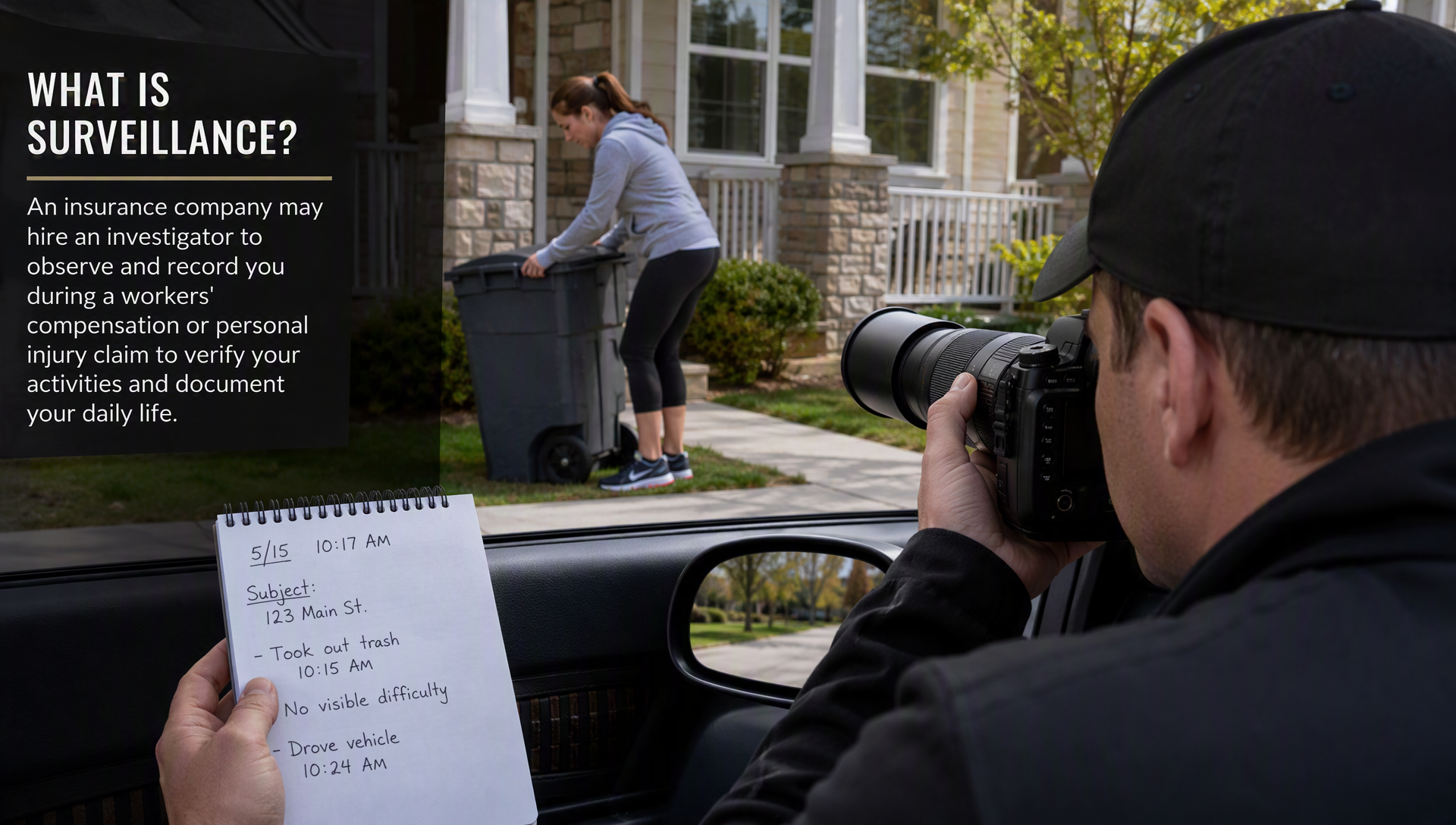
Yes, in the sense that an insurance company may hire an investigator to observe and record you during a workers’ compensation or personal injury claim. An investigator may watch you from a public street, follow you while you drive, observe you in a public parking lot, and record activities that can be seen while you are in public.
No, in the sense that surveillance should usually be much less concerning when you are honest about your injuries and your activities are reasonably consistent with what you tell your doctors.
The purpose of surveillance is often to determine whether your observed activities match the symptoms, physical limitations, and work restrictions you have reported. Surveillance becomes more damaging when it shows a significant contradiction, such as a person claiming that they cannot lift anything while being recorded repeatedly performing heavy construction work.
Most surveillance is far less dramatic. It may show someone driving, walking into a store, buying groceries, attending an appointment, or completing an ordinary household task. The fact that someone can perform one activity for a few minutes does not necessarily mean that person can perform physical labor for eight hours a day.
Surveillance is one of the tools an employer, insurance carrier, or defense attorney may use to investigate an injury claim.
In a North Carolina workers’ compensation case, the insurance company may be paying medical expenses and weekly disability benefits while the injured worker remains out of work or works under restrictions. The carrier may want to determine whether the worker is:
Surveillance may also be used in a North Carolina personal injury claim. A liability insurance company may investigate whether an accident victim’s activities are consistent with the injuries and damages being claimed.
Not every case receives surveillance. It is more likely to be considered when substantial disability benefits are being paid, a person has been out of work for an extended period, the physical restrictions are disputed, the potential value of the case is significant, or the carrier believes there may be a credibility issue.
Insurance companies generally may hire licensed investigators to observe activities that occur in public or are plainly visible from a lawful public location.
Depending on the circumstances, an investigator may observe from:
An investigator may follow your vehicle on public roads and may follow you into a store or other public business. Investigators often record from inside their vehicles, but they may also use smaller cameras while walking through a public location.
An investigator generally cannot trespass onto your private property merely to obtain a better view. The investigator also does not have an unlimited right to enter your home, private garage, fenced yard, or another place where there is a reasonable expectation of privacy.
The precise legal boundaries depend on where the investigator is located, what is being recorded, how the recording is made, and whether the investigator is lawfully present. Anyone who believes an investigator has trespassed, harassed them, or used an unlawfully intrusive method should document what occurred and speak with an attorney.
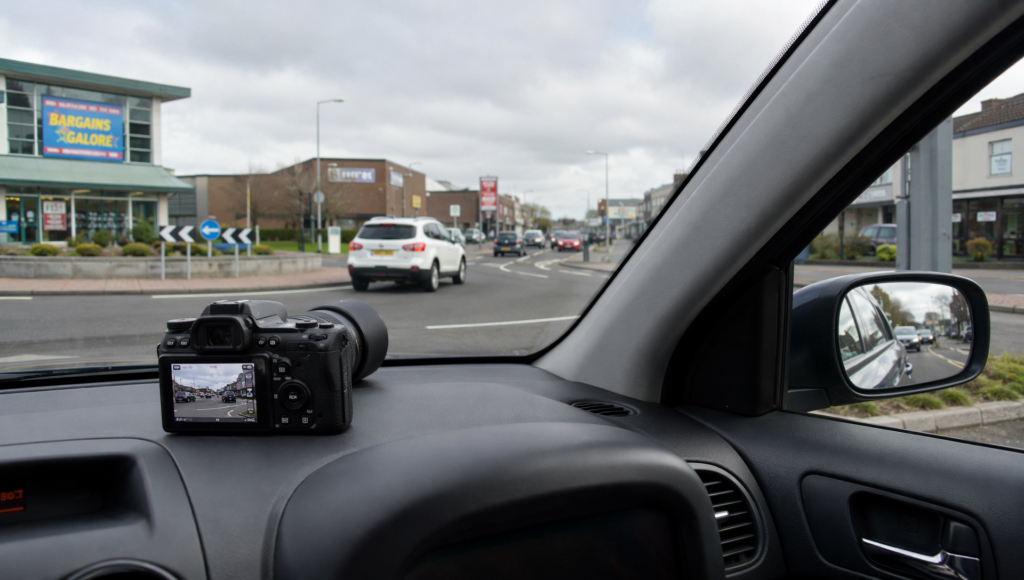
Traditional surveillance often involved an investigator sitting in a vehicle near an injured person’s home for several hours. That still happens, but surveillance methods have changed as cameras have become smaller, less expensive, and easier to conceal.
An investigator may use:
Some surveillance companies now use unattended cameras rather than paying an investigator to sit at the location all day. I have seen situations in which a hidden camera was placed inside an ordinary roadside object, such as a traffic cone, to record activity over an extended period.
The company can later review the footage and keep only the portions it considers useful. This can make long term surveillance less expensive than assigning an investigator to remain physically present for every hour of recording.
An investigator may follow a person on public roads while obeying applicable traffic and safety laws.
The investigator may be attempting to determine:
For example, an investigator may follow someone from home to a grocery store, record the person entering and leaving the store, and observe whether the person carries bags or loads items into a vehicle.
The investigator may also enter the store and walk through public areas while recording with a small camera. Modern equipment can be attached to clothing or incorporated into glasses, making the recording difficult to notice.
Investigators are usually looking for evidence that appears inconsistent with what the injured person has reported to doctors, therapists, the insurance company, or the court.
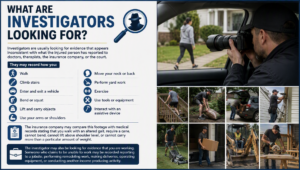
They may record how you:
The insurance company may compare this footage with medical records stating that you walk with an altered gait, require a cane, cannot bend, cannot lift above shoulder level, or cannot carry more than a particular amount of weight.
The investigator may also be looking for evidence that you are working. Someone who claims to be unable to work may be recorded reporting to a jobsite, performing remodeling work, making deliveries, operating equipment, or conducting another income producing activity.
An injured person does not have to look visibly disabled every second of the day. Many injuries fluctuate. People have better days and worse days. Medication may help temporarily. Physical activity may be possible for a limited time but cause increased pain later.
The more important issue is whether your activities are reasonably consistent with what you have reported.
For example, there is an important difference between saying:
“I cannot lift anything at all.”
and saying:
“I can occasionally lift a light object, but repeated lifting causes increased pain and I cannot do it throughout a workday.”
If the second statement accurately describes your condition, a short video of you carrying one grocery bag may not be inconsistent at all.
Problems are more likely to arise when someone uses absolute statements that the evidence later disproves. Be accurate and specific when discussing your abilities. Do not exaggerate, but do not minimize your symptoms either.
One of the most important issues in a surveillance dispute is the difference between performing an activity once and performing it repeatedly throughout a full workday.
Suppose an investigator records an injured worker lifting a 25 pound bag of dog food from a shopping cart into a vehicle. That video may show that the person was physically capable of lifting the bag one time.
It does not necessarily prove that the person can:
The same principle applies when surveillance shows someone mowing part of a lawn, carrying groceries, washing a vehicle, using a tool, or climbing a ladder briefly.
The insurance company may argue that the activity demonstrates a greater physical capacity than the person has reported. The injured worker may respond that the task was performed only once, required rest breaks, caused increased pain, or resulted in symptoms that lasted for several days.
Surveillance records what happened while the camera was present. It generally does not show how the person felt later that evening, whether medication was required afterward, or whether the activity caused a significant flare for the next two days.
Orthopedic injuries, chronic pain, concussions, and other medical conditions do not always cause identical symptoms every day.
A person may be able to perform a household task on one morning and then experience increased pain, swelling, fatigue, dizziness, or other symptoms afterward. The existence of a better day does not necessarily mean that the underlying condition has resolved.
At the same time, an injured person should accurately describe these fluctuations to the treating provider. If you have good days and bad days, explain that. If you can perform an activity but suffer afterward, explain that as well.
Accurate medical histories make it easier to place a short surveillance video into the proper context.
Before representing injured workers, I spent years representing employers and insurance companies. I have seen surveillance that uncovered serious credibility concerns, surveillance that was overstated, and surveillance that proved almost nothing.
The following examples have been modified to protect the identities of the people involved.
One of the most persuasive surveillance cases I handled as a defense attorney involved a granite quarry worker who was injured when a pneumatic airbag used to separate large granite slabs exploded near his face.
The accident itself was not disputed. A coworker testified that the airbag had been overinflated and exploded with tremendous force, describing it as “stronger than a shot from a rifle.” The blast allegedly blew the worker’s hard hat and safety glasses approximately 100 feet away. The worker initially complained of eye pain, but later included concussion-like symptoms of headaches, dizziness, and pressure in his head.
The real dispute was not whether an accident occurred, but how severe the injuries were and whether the worker remained disabled months later. The worker continued to report headaches, dizziness, neck pain, and post-concussion symptoms more than nine months after the accident. His treating neurologist diagnosed post-concussion syndrome and cervical radiculopathy and kept him out of work.
However, within three months of the injury, surveillance investigators recorded the worker regularly visiting his father-in-law’s home, where a major remodeling project was underway. The video showed him carrying doors, countertops, insulation, and other building materials around the property. Investigators also noted that he did not appear to exhibit any obvious physical limitations while performing those activities.
The surveillance footage was then shown to the treating neurologist. After reviewing the video, the doctor changed his opinion regarding the worker’s condition and work capacity.
The Deputy Commissioner summarized the doctor’s testimony as follows in the Opinion and Award:
46. Upon reviewing the surveillance video, Dr. R testified that the video changed his opinion about the severity of Plaintiff’s cervical radiculopathy and that “doing some of the things that we saw in the video would in a moderate or more severe post concussive syndrome will be hard to do or at minimum would definitely worsen his symptoms significantly.” Two of the three surveillance videos took place between Plaintiff’s first and second appointments with Dr. R. Dr. R testified that Plaintiff’s symptoms were not more severe in the second exam as compared to his first exam.47. Dr. R further testified after reviewing the surveillance video that he believes Plaintiff would be capable of some work effective on the date of the surveillance – the first day of surveillance being September 4, 2015.
The Industrial Commission ultimately concluded that the worker had suffered a compensable injury, but that he failed to prove ongoing disability after the date surveillance first showed him performing those activities.
The lesson is not that surveillance automatically defeats a claim. Rather, surveillance is often most persuasive when it changes the opinion of a treating physician. Once a doctor concludes that the activities shown on video are inconsistent with the patient’s reported limitations, the medical evidence supporting the claim may change as well.
In another case, surveillance investigators recorded one of my clients exercising in her garage. The video showed her performing jumping jacks, pushups, and other exercises.
She had previously undergone wrist surgery and continued to report limitations with heavy lifting and certain wrist movements. The insurance company argued that the surveillance demonstrated a greater level of physical ability than was reflected in her medical records and was inconsistent with her claim that she would have permanent work restrictions affecting her future earning capacity.
The surveillance was presented during mediation as evidence that her long-term disability might not be as significant as originally claimed. Although the parties ultimately reached a fair settlement, the surveillance became an important factor in evaluating the value of future wage loss and permanent disability.
The lesson is not that exercising automatically hurts a workers’ compensation claim. In many cases, doctors actually encourage exercise as part of the recovery process. Instead, the important question is whether the type of activity, the amount of weight being used, the range of motion, the duration of the exercise, and the overall level of exertion are consistent with the symptoms and restrictions being reported to treating physicians.
Surveillance is most effective when it creates a meaningful inconsistency between what a claimant says they can do and what the video appears to show. If your activities are consistent with your medical condition and restrictions, surveillance is often far less persuasive.
In another workers’ compensation case, defense counsel advised me during mediation that surveillance had captured my client purchasing a new chainsaw, unboxing it, adding oil and fuel, and preparing to start it.
According to defense counsel, my client then noticed the surveillance vehicle, looked in its direction, put the chainsaw back into the garage, and closed the garage door. The surveillance did not show him actually operating the chainsaw or performing any tree cutting or other strenuous physical labor.
The insurance company nevertheless used the surveillance to question the severity of my client’s injuries. Their argument was straightforward: if someone claims to be physically unable to return to work, why would they purchase and prepare a chainsaw for use?
I was never provided the opportunity to personally review the surveillance footage, and because the video ended before any chainsaw use occurred, it left important questions unanswered. Preparing a chainsaw for use is very different from spending hours cutting trees, lifting heavy logs, or performing repetitive physical labor.
Ultimately, the parties were still able to reach a settlement that included several years of future disability benefits. However, the surveillance likely had a small impact on the value of the claim because it created uncertainty about my client’s future work capacity, even though it did not show the type of prolonged physical activity the insurance company hoped to capture.
This example illustrates that surveillance can have value even when it does not capture the activity the insurance company was hoping to see. A video of my client actually cutting trees for several hours would have been far more damaging. Instead, the surveillance captured only the preparation. Even so, the insurance company argued that purchasing, fueling, and preparing a chainsaw supported the inference that my client intended to engage in strenuous physical activity. That circumstantial evidence did not defeat the claim, but it likely reduced its settlement value by creating additional questions about his physical capabilities.
Most surveillance does not reveal someone secretly remodeling a house, running a chainsaw, or lifting heavy weights.
It may show the person:
Those ordinary activities do not automatically establish that someone can return to a physically demanding occupation.
A person who can walk through a grocery store for 20 minutes may not be able to stand on a factory floor for eight hours. A person who can lift one item may not be able to unload trucks throughout a shift. A person who bends once to pick something up may not be able to bend hundreds of times during warehouse work.
The defense may attempt to present ordinary activity in the strongest possible light. The injured worker’s attorney may respond by placing the activity in context and explaining the difference between occasional activity and sustained work capacity.
No. Surveillance is one piece of evidence and must be considered in context.

The North Carolina Industrial Commission may consider the footage along with:
A short video does not necessarily represent an entire day, week, or month. It also does not automatically establish that a person can safely perform sustained work.
Surveillance becomes more significant when it directly contradicts an important statement. Examples could include someone testifying that they have not worked while being recorded performing paid labor, or someone claiming never to lift with one arm while repeatedly using that arm to carry heavy materials.
Even then, the circumstances surrounding the footage remain important. The date, duration, editing, camera angle, identity of the person, nature of the activity, and symptoms afterward may all require examination.
Usually, you will not know while the surveillance is taking place.
The insurance company generally has little reason to announce that an investigator is watching you. Once someone knows about surveillance, that person may become guarded and behave differently. If the insurer believes someone is engaging in questionable conduct, advance notice could cause the conduct to stop.
If the surveillance captures nothing useful, you and your attorney may never learn that it occurred.
If the carrier believes the video helps its position, the footage may arise during:
Surveillance is sometimes raised for the first time during mediation. The defense may show the footage to everyone, show only selected clips, describe the footage without playing it, or show it privately to the mediator.
When only the mediator sees the video, the mediator may provide a general assessment of whether it appears important. That can place the injured person and the attorney in a difficult position because they may be asked to evaluate settlement risk without having personally reviewed the complete recording.
The way surveillance must be disclosed depends on how the defense intends to use it, the applicable discovery rules, Industrial Commission procedure, any case management orders, and the stage of the claim.
Yes. In a North Carolina workers’ compensation case, the employer or insurance carrier may seek to send surveillance or other additional information to an authorized treating provider.
However, the carrier must follow the procedure established by N.C. Gen. Stat. § 97-25.6(d).
Before submitting the additional information, the employer must provide written notice that it intends to communicate with the health care provider. That notice must include the proposed written communication and the additional information the employer intends to submit.
The employee then has 10 business days from the postmark or verifiable fax or email to consent or object.
If the employee consents, or does not timely object, the employer may send the information to the provider.
If the employee timely objects, the employee may request a protective order from the North Carolina Industrial Commission. The employer must refrain from communicating the material to the provider until the Commission rules on the request. The Commission considers whether the proposed communication and information are pertinent and necessary to the fair and efficient resolution of the claim and whether another method exists to obtain the information.
Although the statute allows a request for a protective order, the request should have a sound factual and legal basis. The Commission may assess costs, including attorneys’ fees and deposition expenses, if it determines that a party acted unreasonably in initiating or objecting to the proposed submission.
This notice process gives the injured worker and attorney an opportunity to:
The physician may then be asked whether the recorded activities affect the diagnosis, treatment plan, work restrictions, disability opinion, or ability to return to work.
Information about workers’ compensation proceedings and forms is also available through the North Carolina Industrial Commission.
A surveillance video does not interpret itself. The insurance company may argue that the footage proves the injured worker can return to work, but the treating physician is often in a better position to evaluate whether the activity is medically significant.
A doctor may conclude that:
In the example discussed above where the injured worker was seen remodeling a house, the surveillance became particularly damaging because the treating doctor changed the work status after seeing what the worker was doing.
In another case, a physician might watch someone carry one bag into a vehicle and conclude that the activity does not establish an ability to perform repetitive lifting throughout a work shift.
The medical response depends on what the video shows and how closely the activity relates to the person’s diagnosis and restrictions.
No. You should not stop living your life merely because surveillance is possible.
You generally should not:
Continue living honestly while following your physician’s restrictions.
If your doctor tells you not to lift more than 10 pounds, do not lift 50 pounds simply because you feel better that morning. If you are permitted to walk, shop, drive, exercise, or perform light household tasks, you do not need to avoid those activities simply because an investigator might see you.
The best protection is not hiding. It is consistency.
Give your doctor an accurate description of what you can and cannot do.
Avoid absolute statements unless they are true. Rather than saying that you can never lift, bend, drive, walk, or perform a household task, explain:
For example:
“I can walk around a store for about 20 minutes, but then my back pain increases and I need to sit down.”
That description provides much more useful information than saying either “I cannot walk” or “I can walk fine.”
If surveillance later shows you walking through a store, the video may be entirely consistent with what you reported.
Do not panic and do not confront the person.
If you believe you are being followed or recorded:
A suspected surveillance vehicle may simply be a neighbor, delivery driver, contractor, utility worker, or another person with a legitimate reason to be nearby. Avoid making accusations without sufficient information.
Yes. Liability insurance companies may use surveillance in automobile accident, premises liability, and other personal injury claims.
The purpose is similar. The insurer may compare the person’s observed activities with allegations involving pain, disability, loss of mobility, inability to work, loss of enjoyment of life, or the need for future care.
The workers’ compensation statute governing communications with authorized treating providers does not automatically control an ordinary personal injury case. Personal injury claims are governed by different discovery rules, medical authorization issues, evidentiary requirements, and court procedures.
However, the practical advice remains the same. Be truthful, follow medical advice, describe your limitations accurately, and recognize that activities occurring in public may be recorded.
During my career, I have represented both insurance companies and injured people, and the experience I have gained from both sides has been tremendously helpful. I have seen surveillance that completely changed a case, surveillance that exposed legitimate credibility concerns and had small impact on a case, and surveillance was taken out of context and proved almost nothing.

My advice is as follows:
If your medical records accurately describe your condition and your public activities are reasonably consistent with those records, surveillance is usually much less concerning than many injured people imagine.
You can learn more about the firm’s experience representing injured workers on our North Carolina Workers’ Compensation Lawyer page. You can also read more about David Galbavy’s experience representing both insurance companies and injured people on the About Galbavy Law page.
Yes. An employer or insurance carrier may hire an investigator to observe an injured worker, particularly in public locations. The investigator must still comply with laws governing trespass, privacy, harassment, and investigative conduct.
Yes. An investigator may generally follow someone on public roads and observe activities in a public parking lot or store. The investigator does not have an unrestricted right to enter private areas.
No. An investigator generally cannot trespass onto private property merely to conduct surveillance. Activities visible from a lawful public location may still be observed and recorded.
Not necessarily. If the surveillance captures nothing the insurance company considers useful, the injured person and attorney may never learn that it occurred. Helpful footage may arise during mediation, discovery, medical review, or a hearing.
Yes. In a North Carolina workers’ compensation claim, an employer may seek to provide additional relevant information to an authorized health care provider. The employer must follow the notice and objection procedure in N.C. Gen. Stat. § 97-25.6(d).
No. The significance of the video depends on what it shows, how long the activity lasted, whether it contradicts prior statements, how the person felt afterward, and how the medical providers interpret the activity.
If surveillance has been raised in your claim, the complete footage should be evaluated carefully. A short clip may be significant, insignificant, misleading, or incomplete depending on the circumstances.
Galbavy Law represents injured workers and personal injury clients throughout North Carolina. We review surveillance in the context of the medical records, work restrictions, testimony, job requirements, and the person’s actual condition.
This article is provided for general informational purposes and is not legal advice. Surveillance, privacy, discovery, medical communication, and evidentiary issues depend on the particular facts, applicable law, and procedural posture of each claim.

Quick Answer: No. The fact that workers' compensation is paying for your medical treatment does...

Quick Summary: North Carolina court records allege that two drivers were participating in a high-speed...

Quick Answer North Carolina requires drivers to maintain automobile liability insurance with minimum limits of...

1 Prior results do not guarantee similar outcomes in future cases because each case is unique and must be evaluated separately. The only way we can assist you is for you to call us about your case.
Protected by reCAPTCHA. Google Privacy Policy and Terms of Service apply.