Quick Answer: Yes. A pre-existing medical condition does not automatically prevent you from receiving North Carolina workers’ compensation benefits. If a work accident or specific traumatic incident materially aggravates or accelerates an existing condition, the resulting medical treatment and disability may be compensable. You generally do not have to prove that work originally caused the arthritis, degeneration, prior surgery, or other underlying condition. The important question is whether the work injury caused a meaningful worsening rather than a temporary flare-up that returned to your prior baseline.
Pre-existing conditions are one of the most common reasons insurance companies investigate or dispute workers’ compensation claims. They may request prior medical records, obtain older imaging studies, compare your condition before and after the accident, and sometimes schedule an independent medical examination.
The existence of a prior condition can make a claim more complicated, but it does not automatically make the claim non-compensable.
North Carolina workers’ compensation law recognizes that employees often have medical conditions before a workplace accident occurs.
Common examples include:
A work injury can still be compensable when it materially aggravates or accelerates one of these conditions.
North Carolina case law recognizes that when a work-related accident or specific traumatic incident aggravates or accelerates a pre-existing condition, the resulting disability may be compensable. See Moore v. Federal Express, 162 N.C. App. 292, 590 S.E.2d 461 (2004).
The law does not necessarily require the workplace accident to be the only cause of the employee’s condition. The employment may be a contributing cause.

A material aggravation generally means the work injury caused a meaningful worsening or acceleration of a pre-existing condition.
For example, an employee may have arthritis that existed for years without causing significant symptoms. After a workplace accident, that same condition may become painful, limiting, and require treatment that was never necessary before.
In that situation, the legal question is usually not:
“Did the work accident cause the arthritis?”
The arthritis may have existed long before the accident, as arthritis usually develops over time.
The more important question is:
“Did the work accident materially aggravate or accelerate the arthritis so that the employee now requires treatment or has limitations that did not exist before?”
If competent medical evidence supports that connection, the treatment resulting from the aggravation may be covered by workers’ compensation.
A material aggravation is different from a temporary exacerbation.
A material aggravation generally means the employee’s condition meaningfully worsened and did not simply return to the pre-injury baseline.
A temporary exacerbation generally involves a short-term increase in symptoms that later resolves, leaving the employee essentially where they were before the accident.
North Carolina courts have distinguished compensable material aggravations from temporary exacerbations. See Mitchell v. Fieldcrest Mills, Inc., 84 N.C. App. 661, 353 S.E.2d 638 (1987), and Demery v. Converse Inc., 138 N.C. App. 243, 530 S.E.2d 871 (2000).
This distinction often becomes the central dispute in cases involving arthritis, degenerative spine conditions, and previous injuries.

Consider a worker who has never treated for significant knee pain and has never been given work restrictions because of the knee.
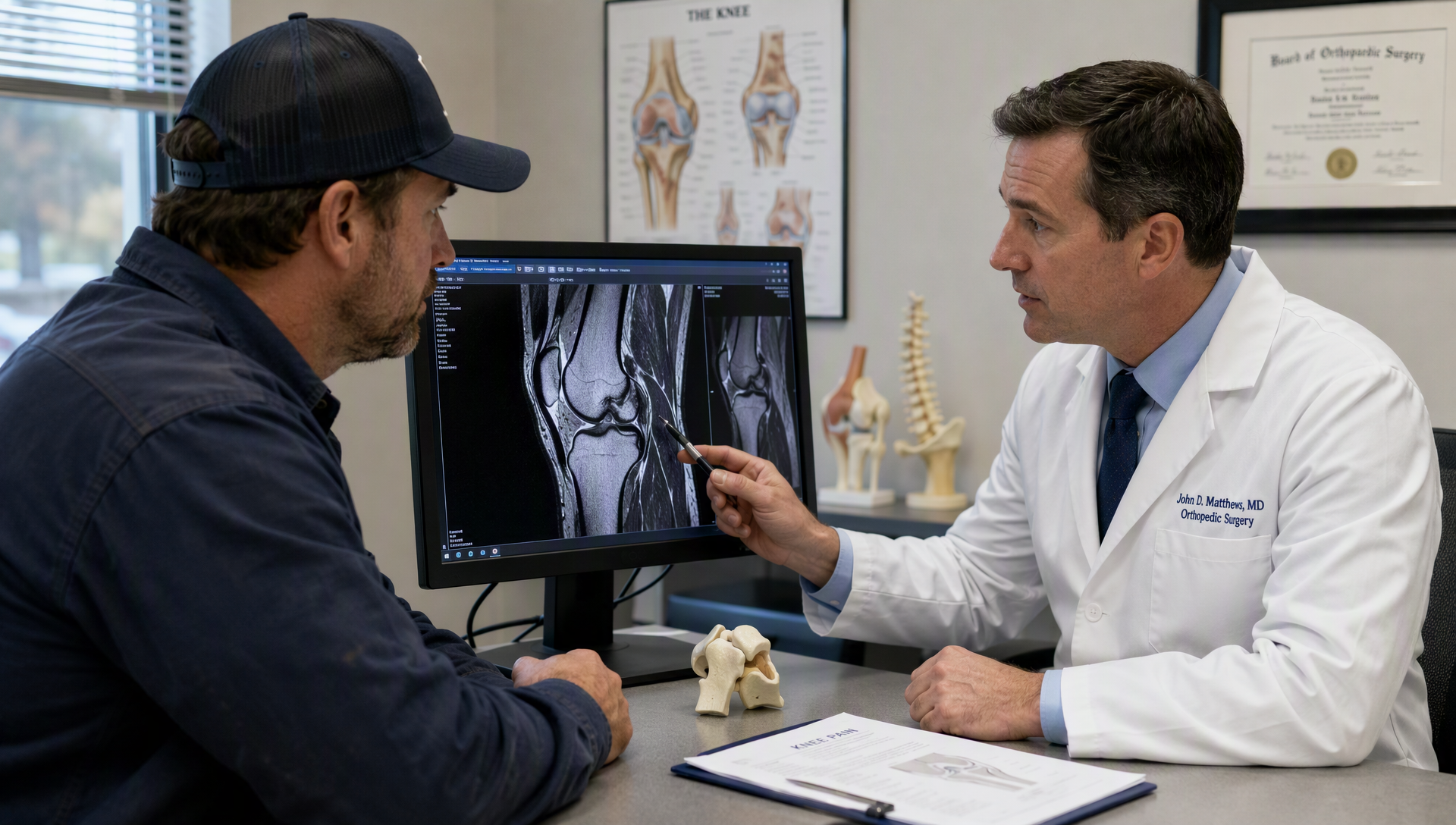
The worker then suffers a compensable workplace accident and tears a meniscus. An MRI also shows significant arthritis.
The meniscus tear is treated, but the employee’s knee never returns to its prior condition. The accident causes increased pain, swelling, reduced mobility, and difficulty performing physical work. Conservative treatment eventually fails, and the orthopedic surgeon recommends a total knee replacement.
The insurance company may argue that the knee replacement is necessary only because of pre-existing arthritis.
However, the employee does not necessarily have to prove that the work accident created the arthritis.
Instead, the employee may prove that:
If the treating physician can provide competent medical testimony supporting that relationship, the knee replacement may be compensable even though the arthritis itself existed before the workplace accident.
A prior back injury, even one that required surgery, does not automatically defeat a later workers’ compensation claim.
Suppose an employee injured the lower back several years earlier, underwent surgery, completed treatment, and returned to full-duty work without restrictions.
Years later, the employee suffers a new work-related back injury and develops renewed or different symptoms.
The insurance company will often obtain the prior medical records and compare the old condition with the new one.
Relevant questions may include:
A prior surgery can actually provide useful evidence of the employee’s pre-injury baseline.
If the employee recovered from the prior surgery, returned to unrestricted work, and remained stable for several years before the new accident, those facts may support the argument that the later work injury caused a new condition or materially aggravated the prior one.

New pathology at a different spinal level may provide additional evidence that the current condition is different from the prior injury.
For example, a prior fusion or surgery at L5-S1 does not automatically explain a later work-related disc herniation at L3-4 or L4-5.
If the new injury involves the same spinal level, the insurance company may more aggressively investigate whether the current symptoms are simply a continuation of the prior condition rather than the result of a new work injury.
An adjacent level may also receive additional scrutiny, particularly when the employee previously underwent a spinal fusion. The carrier may argue that the new condition developed gradually because of degeneration or increased stress on the levels above or below the prior fusion rather than because of the new workplace incident.
However, involvement of the same or an adjacent spinal level does not automatically defeat the claim. A new workplace accident may still be compensable if it materially aggravated or accelerated the prior condition, caused new pathology, or resulted in a meaningful and lasting change in symptoms, restrictions, or treatment needs.
Again, the issue is not simply whether a prior condition existed. The more important question is whether the employee’s condition materially changed after the new workplace injury.
When an insurance carrier learns that an injured employee has prior treatment involving the same body part, it will often investigate further.
That investigation may include requests for:
The insurance company is usually trying to determine the employee’s condition before the accident and whether the workplace injury caused a meaningful change.
Important questions may include:
The mere fact that prior medical records exist does not mean the claim should be denied. Those records may actually help establish how well the employee was functioning before the new injury.

One of the most important comparisons in a pre-existing-condition case is the employee’s functional condition before and after the workplace injury.
Relevant questions include:
An MRI may show significant arthritis or degeneration even when the employee had little or no functional limitation before the accident.
For that reason, medical imaging alone does not always tell the entire story.
Pre-existing-condition cases often turn on medical causation.
The injured employee bears the burden of proving that the work injury caused or materially aggravated the condition for which benefits are being sought.
When the medical question is complex, North Carolina law generally requires competent expert medical testimony. See Click v. Freight Carriers, 300 N.C. 164, 265 S.E.2d 389 (1980), and Hodgin v. Hodgin, 159 N.C. App. 635, 583 S.E.2d 362 (2003).
The medical evidence must generally rise above speculation or mere possibility.
Statements such as:
“The accident could have aggravated the condition.”
or
“It is possible that work contributed.”
may be insufficient when the case involves a complex medical causation question.
The stronger opinion is generally that the accident more likely than not materially aggravated or accelerated the pre-existing condition.
North Carolina law does not necessarily require the doctor to say the workplace injury was the only cause. A contributing causal relationship may be enough.

When the insurance company disputes medical causation, it may require the employee to attend an independent medical examination, commonly called an IME.
Under N.C.G.S. § 97-27, an employer or insurance carrier may require an employee to submit to an examination under certain circumstances, even in a denied claim.
The insurance company generally selects and pays the physician conducting the examination.
An IME may be requested to evaluate:
The IME physician may disagree with the authorized treating physician.
That disagreement does not automatically resolve the case in favor of either party.
It is common for a workers’ compensation case involving a pre-existing condition to contain conflicting medical opinions.
For example, the treating orthopedic surgeon may testify:
“The workplace accident materially aggravated the employee’s arthritis and accelerated the need for knee replacement.”
The insurance company’s IME physician may instead conclude:
“The knee replacement is necessary solely because of pre-existing degenerative arthritis.”
If the parties cannot resolve the dispute, the North Carolina Industrial Commission may ultimately decide which medical opinion receives greater weight.
The Commission may consider factors such as:
The Industrial Commission is responsible for determining the credibility and weight of conflicting evidence.
One of the most common misconceptions in workers’ compensation cases is that an MRI showing arthritis or degeneration automatically means the insurance company is not responsible.
That is incorrect.
Degenerative findings are common, particularly as people age. Many employees have arthritis, degenerative disc disease, or other abnormalities without significant symptoms and without any need for treatment.
The existence of degeneration does not answer the more important question:
What changed after the workplace accident?
If the employee was working full duty without treatment before the accident and afterward developed persistent pain, restrictions, surgery recommendations, or other significant limitations, the work injury may have materially aggravated the prior condition.

When I evaluate a claim involving a pre-existing condition, I generally do not focus only on whether an old MRI showed arthritis or whether the employee previously had surgery.
I want to know what the employee was actually able to do before the new accident.
Was the employee working full duty? Was there ongoing treatment? Were there restrictions? Was another surgery already planned? How long had the employee been stable?
Those facts often tell us much more about whether a material aggravation occurred than the simple existence of an old diagnosis.
The knee-replacement example is very common. A worker may have had arthritis for years without knowing it. After an acute meniscus injury, the knee may never return to baseline, and the accident may accelerate the need for replacement surgery.
The same concept applies to a prior back injury. An employee may have undergone surgery years earlier, returned to unrestricted work, and remained stable until a new workplace injury caused renewed symptoms, new pathology, or new restrictions.
Pre-existing conditions frequently cause insurance companies to investigate more aggressively and, in many cases, initially deny the claim rather than voluntarily accept responsibility for the aggravation. An initial denial does not mean the worker does not have a compensable claim or will never receive benefits. These disputes are often resolved through negotiation and settlement, while others require the parties to present competing medical evidence to the North Carolina Industrial Commission. In my experience, insurers often prefer to deny a disputed aggravation claim and negotiate its value rather than immediately accept responsibility for ongoing medical treatment and disability benefits.
A pre-existing condition can make a North Carolina workers’ compensation claim more complicated, but it does not automatically prevent recovery.
North Carolina law recognizes compensable material aggravations and accelerations of pre-existing conditions. The employee generally must prove that the workplace accident or specific traumatic incident caused a meaningful worsening rather than a temporary flare-up that returned to baseline.
In many cases, the central issues are:
When doctors disagree, the North Carolina Industrial Commission may ultimately determine which medical opinion is more persuasive.
For more information about the legal standards governing workplace injuries, read Galbavy Law’s North Carolina Workers' Compensation Guide.
If your workers’ compensation claim is being disputed because of arthritis, prior surgery, or another pre-existing condition, contact Galbavy Law for a free consultation of your case.
This article is provided for general informational purposes and is not legal advice. Workers’ compensation claims depend on the specific facts, medical evidence, applicable law, forms filed, and procedural history of the individual claim.

Many injured workers are surprised to learn that not every injury that happens at work...

Quick Answer Yes, in the sense that an insurance company may hire an investigator to...

Quick Summary: Three common mistakes that can create unnecessary problems in a North Carolina workers'...

1 Prior results do not guarantee similar outcomes in future cases because each case is unique and must be evaluated separately. The only way we can assist you is for you to call us about your case.
Protected by reCAPTCHA. Google Privacy Policy and Terms of Service apply.