
Quick Answer: No. The fact that workers' compensation is paying for your medical treatment does not necessarily mean your North Carolina workers' compensation claim has been accepted.
An employer or insurance carrier can pay medical benefits without prejudice, meaning it can authorize doctors, physical therapy, diagnostic testing, and other treatment while reserving the right to later deny that the injury is compensable.
This situation is particularly common at the early stages of a claim and when an injured employee continues working, including in a light-duty position, and therefore is not eligible for weekly disability benefits.
Everything may appear to be going smoothly.
You are seeing a doctor. Workers' compensation is paying the bills. Physical therapy is authorized. Your adjuster may be scheduling appointments.
Then something changes...
Your doctor recommends surgery. You are taken completely out of work. A significant pre-existing condition becomes an issue. Or the insurance company finishes its investigation and decides that it does not believe your injury is legally compensable.
An employee who assumed the claim had already been accepted can suddenly discover that it wasn't.
North Carolina workers' compensation law allows an employer or insurance carrier to respond to a claim in several different ways.
The carrier can formally accept the claim.
It can deny the claim.
Or, under certain circumstances, it can provide benefits without prejudice, meaning benefits are being provided without an admission that the insurance company is legally responsible for the claim.
The North Carolina Industrial Commission uses different forms to document these decisions.
A Form 60, Employer's Admission of Employee's Right to Compensation, generally represents an acceptance of the employee's right to workers' compensation benefits.
A Form 61, Denial of Workers' Compensation Claim, tells the employee that the employer or insurance carrier is denying the claim and should identify the grounds for the denial.
A Form 63, Notice to Employee of Payment of Compensation Without Prejudice or Payment of Medical Compensation Without Prejudice, allows benefits to be provided without necessarily accepting liability for the underlying claim.
The Form 63 contains two substantially different sections and is often a source of confusion.
Section 1 applies when the carrier is paying indemnity benefits, meaning monetary disability compensation, as well as medical benefits.
Section 2 applies when the carrier is paying medical benefits only.
This article focuses on Section 2: Medical Benefits Only.
The phrase medical-only claim is commonly used when the insurance carrier is paying workers' compensation medical expenses but the employee is not receiving weekly disability compensation.
A common example is an employee who gets hurt at work, reports the accident, and is sent to an authorized doctor.
The doctor allows the employee to continue working but with light duty restrictions.
The employer accommodates those light-duty restrictions with a modified job assignment.
Meanwhile, workers' compensation may pay for:
From the employee's perspective, this certainly looks like an accepted workers' compensation claim.
But legally, it may not be.
The carrier may be paying those medical expenses without prejudice while retaining the ability to later dispute compensability.
Section 2 of the North Carolina Industrial Commission's Form 63 is specifically designated for medical benefits only.
It states that payment of medical compensation is being made without prejudice to the employer or carrier's ability to later deny the compensability of the claim.
In plain English, the carrier is essentially saying:
"We are going to pay for your medical treatment right now, but we are not admitting that we are legally responsible for your workers' compensation claim."
This distinction may not seem important while treatment is being authorized.
It can become extremely important later.
This is one of the most important distinctions between a medical-only claim and a claim where the employee is receiving weekly disability compensation.
You may hear that a North Carolina workers' compensation insurance carrier has 90 days to investigate a claim while paying benefits without prejudice.
That rule applies to compensation paid without prejudice under N.C.G.S. § 97-18(d) and Section 1 of Form 63.
Under that procedure, the carrier generally has a 90-day investigation period from the employer's written or actual notice of the injury, with a possible extension of up to 30 additional days.
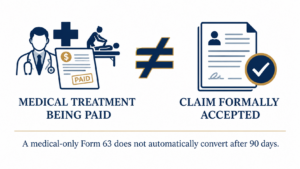
But a medical-only Form 63 is different.
The North Carolina Industrial Commission's Form 63 expressly states that Section 2 medical benefits are paid without prejudice and are not subject to the 90-day requirement applicable to Section 1.
This means an employee can potentially receive workers' compensation medical treatment for months without the claim automatically becoming accepted simply because 90 days have passed.
There is no equivalent automatic conversion into an accepted claim merely because the carrier has continued paying medical expenses.
That is a critical difference between:
Medical benefits only under Section 2 of Form 63
and
Disability and medical benefits under Section 1 of Form 63.
If you are receiving weekly workers' compensation disability checks in addition to medical treatment, different deadlines and legal consequences may apply.
There are legitimate reasons North Carolina's workers' compensation system allows medical treatment to be paid without prejudice.
Investigating a claim takes time.
An insurance adjuster may need to obtain:
Meanwhile, an injured employee may need medical treatment immediately.
A system that required the carrier to either completely accept responsibility for a claim or refuse to provide any treatment during its investigation could discourage carriers from providing any treatment while questions remain unresolved.
Payment without prejudice allows medical care to move forward without necessarily requiring the insurance company to immediately concede compensability.
The practical problem is that many injured workers do not realize the claim remains unaccepted.
The legal status of a medical-only claim may not seem particularly important while the employee remains at work and treatment is being authorized.
The problem often appears when the stakes increase.
Suppose workers' compensation has paid for several months of physical therapy, an MRI, injections, and orthopedic appointments.
Conservative treatment fails.
Your surgeon now recommends an operation.
The insurance carrier may take a much closer look at whether it believes the proposed surgery is actually related to the workplace accident.
An employee may be surprised to learn that the carrier's prior payment of conservative treatment did not necessarily constitute an acceptance of the underlying claim.
Suppose you have continued working light duty while workers' compensation paid for your medical treatment.
Then your condition worsens or surgery becomes necessary, and the doctor takes you completely out of work.
Now the claim potentially involves weekly disability compensation in addition to medical expenses.
You may reasonably assume:
"They've been paying my doctors for three months, so they'll start sending me weekly checks."
That does not necessarily follow.
The carrier may now have to address whether it accepts liability for the underlying claim and whether disability benefits are owed.
An MRI or medical-record review may reveal substantial degenerative changes (arthritis) or an old injury involving the same body part.
The insurance company may investigate whether the employee's current need for treatment resulted from the workplace accident or from the pre-existing condition.
A pre-existing condition does not automatically defeat a North Carolina workers' compensation claim. (Read more about pre-existing conditions.)
But it can create a significant medical-causation dispute, particularly where the carrier has never formally accepted the claim.
The insurance company may also question whether the incident satisfies North Carolina's legal requirements for a compensable workplace injury.
For example, depending upon the type of injury, the carrier may investigate whether there was a qualifying injury by accident, whether the injury arose out of and in the course of employment, or whether the medical condition was actually caused or materially aggravated by the work event.
The fact that medical treatment was previously authorized does not necessarily prevent the carrier from raising these issues when the claim has not been formally accepted.
Do not assume that payment of your medical bills answers the question.
Review the Industrial Commission paperwork filed in your claim.
In particular, determine whether the carrier filed a:
If there is a Form 63, determine which section was completed.
Section 1 and Section 2 have substantially different legal consequences.
Do not simply ask:
"Is workers' comp paying for my doctor?"
Also ask:
"Has the insurance company actually accepted my workers' compensation claim?"
If workers' compensation is paying for your doctor, physical therapy, prescriptions, and other treatment, you may reasonably wonder:
"Why do I care whether my claim is formally accepted if they're already paying my medical bills?"
The distinction may not seem important while everything is going smoothly.
It can become extremely important when something goes wrong.
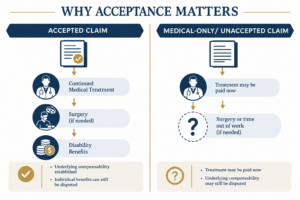
When an insurance carrier formally accepts a workers' compensation claim, it has acknowledged responsibility for the compensable injury identified in the acceptance.
That does not mean every future treatment request will automatically be approved or that every new medical condition will necessarily be covered.
Disputes can still arise over whether particular treatment is medically necessary, whether another body part is causally related, the extent of disability, or other benefits.
But there is an important difference between arguing over what benefits are owed in an accepted claim and having to first establish whether you have a compensable workers' compensation claim at all.
With a medical-only Form 63, that underlying compensability issue may remain unresolved.
Formal acceptance can also affect the procedures available when a dispute develops.
In an accepted or otherwise established compensable claim, disputes over authorized medical treatment can often be presented to the North Carolina Industrial Commission through administrative procedures, which are quicker than a full-scale hearing that also has to determine compensability.
Depending upon the circumstances, these administrative disputes may involve issues such as:
If the carrier has never accepted the underlying claim and compensability remains disputed, the employee may first have to establish the compensability of the claim rather than simply asking the Industrial Commission to resolve a particular medical-benefit dispute. A compensability hearing generally includes lay witness testimony, expert witness testimony (doctors), and written briefs, and it can take a year or more for the Commission to issue a formal opinion and award, and then up to another year on appeal.
That procedural distinction can affect how a treatment dispute is addressed.
Consider an employee who has been working light duty while workers' compensation pays for conservative medical treatment under a medical-only Form 63.
For several months, there may be no obvious problem.
Then the doctor recommends surgery and takes the employee completely out of work.
Two new questions suddenly become extremely important:
Who is going to pay for the surgery?
Who is going to replace the employee's lost wages while the employee cannot work?
If the claim was formally accepted, the dispute may focus on whether those particular benefits are related to and required by the accepted injury.
If the claim was never accepted, the insurance carrier may still dispute the underlying compensability of the claim itself.
The employee who thought everything was settled because workers' compensation had been paying medical bills may suddenly discover that the most fundamental issue in the case remains unresolved.
It is equally important not to overstate what acceptance means.
An accepted workers' compensation claim can still involve significant disputes.
The insurance company may contest:
An accepted claim is therefore not a blank check.
But it generally puts the employee in a substantially better position from someone whose carrier has merely been voluntarily paying medical expenses without accepting responsibility for the underlying claim.
In an accepted claim, the starting point is that a compensable injury exists. In an unaccepted medical-only claim, that underlying injury may still be contested.
North Carolina requires employers and insurance carriers to comply with claims-administration requirements.
The Industrial Commission's Claims Administration Section processes Form 60, Form 61, and Form 63 filings and assesses certain penalties when employers or insurers fail to comply with filing requirements.
But an injured worker should not assume that a carrier's failure to timely file the appropriate paperwork means the employee automatically wins the workers' compensation claim. Rather, the failure to file an appropriate form on time results in a small penalty fee and has no impact on the carrier's ability to defend the merits of the case.
That is particularly important in a medical-only claim because Section 2 of Form 63 is expressly not subject to Section 1's 90-day automatic-conversion framework.
If the status of the claim is unclear, determine what forms have actually been filed rather than assuming that the carrier's payment of medical bills established compensability. You may also request the Commission to order the Defendants to accept or deny the claim by filing a Motion to Compel.
A denial does not necessarily mean the insurance company has the final word.
It means there is now a dispute.
An employee can pursue a denied claim before the North Carolina Industrial Commission by filing a Form 33, Request That Claim Be Assigned for Hearing.
The employee may ultimately establish compensability even though the insurance carrier initially denied the claim.
A denial can have an important practical consequence for medical treatment.
In an accepted or otherwise compensable North Carolina workers' compensation claim, the employer or insurance carrier generally provides and directs medical treatment, subject to orders of the Industrial Commission.
If the carrier denies the claim and refuses to provide further treatment, the employee may need to obtain medical treatment independently.
Depending upon the circumstances, that may include selecting medical providers and using private health insurance when available rather than continuing to wait for the workers' compensation carrier to authorize treatment.
That can sometimes give an injured worker more practical control over obtaining needed medical care.
But it can also create additional issues involving deductibles, copayments, health-insurance reimbursement rights, medical liens, and whether independently obtained treatment will ultimately be related to a later workers' compensation award.
An employee should therefore get individualized legal advice rather than assuming either that a denial means medical treatment must stop or that any treatment obtained independently will automatically be paid by workers' compensation later.
This is important to remember.
If workers' compensation is authorizing appropriate medical care, that is a positive development.
But do not confuse:
"Workers' compensation is currently paying my doctor."
with:
"The insurance company has formally accepted legal responsibility for my workers' compensation claim."
It is very common for the workers' compensation carrier to start paying for medical treatment then later deny a claim. It has minimal cost to them and they get to find out more about your injuries without committing to long-term benefits.
You do not have to wait until medical treatment is denied to speak with a workers' compensation attorney.
An attorney can review the Industrial Commission file, determine what forms have been filed, identify whether the claim has actually been accepted, and evaluate potential compensability issues before they become larger problems.
Depending on the claim status, an attorney can also evaluate what legal avenues are available to force any acceptance or denial, or how to push any denied benefits.
Legal advice can be particularly useful when:
Getting legal advice early does not guarantee that an insurance company will accept the claim.
It does allow you to understand where the claim actually stands before a significant problem develops.
If workers' compensation is paying your medical bills in North Carolina, do not automatically assume your claim has been accepted.
The insurance carrier may be paying medical benefits without prejudice through Section 2 of a Form 63 while retaining the ability to later dispute compensability.
A medical-only Form 63 does not automatically become an accepted claim simply because 90 days have passed.
And if a significant issue later develops, such as surgery, disability from work, a pre-existing condition, or a medical-causation dispute, the legal status of the claim can suddenly become extremely important.
Review the forms filed in your case. Understand whether the claim has actually been accepted. And do not assume that payment of your medical bills answers that question.
David Galbavy is a North Carolina Board Certified Specialist in Workers' Compensation Law and represents injured workers throughout North Carolina.
Learn more about workers' compensation representation from Galbavy Law's Charlotte Workers' Compensation Lawyer and Hickory Workers' Compensation Lawyer pages, or contact Galbavy Law to discuss your claim.
This article is provided for general informational purposes and is not legal advice. Every workers' compensation claim depends upon its particular facts and procedural history.
Quick Answer: Yes. A pre-existing medical condition does not automatically prevent you from receiving North...

Quick Answer: Under North Carolina workers’ compensation law, an injury by accident generally requires an...

What Is a Specific Traumatic Incident in a North Carolina Workers' Compensation Case? Quick Answer:...

1 Prior results do not guarantee similar outcomes in future cases because each case is unique and must be evaluated separately. The only way we can assist you is for you to call us about your case.
Protected by reCAPTCHA. Google Privacy Policy and Terms of Service apply.