Pedestrians have no protection when a vehicle strikes them, which is why these accidents so often lead to serious or life-changing injuries. Broken bones, head trauma, and spinal injuries are common, even at low speeds. Recovery can take months, and some injuries never fully heal.
Many pedestrian accidents in Asheville happen when drivers fail to yield in crosswalks, speed through intersections, or drive distracted. Proving fault matters, especially in North Carolina, where even a small share of blame can block compensation. Strong evidence showing the driver caused the crash is critical.
A pedestrian accident lawyer can investigate what happened, gather traffic footage and witness statements, and deal with insurance companies on your behalf. That work allows you to focus on healing while your claim moves forward and your future care needs are taken seriously.
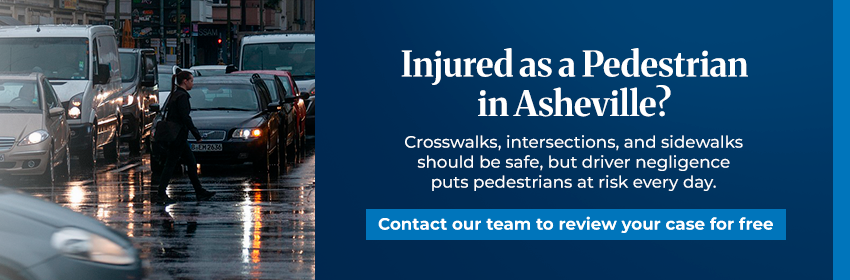
Pedestrian accidents in Asheville tend to happen in busy areas where foot traffic and vehicle traffic collide. High speeds, distracted driving, and poor visibility all play a role, especially in places where drivers are not expecting people to cross the road.
Some of the most common locations include:
Downtown accidents often increase at night near bars and restaurants, when visibility drops, and drivers may be impaired. On commercial corridors like Tunnel Road, faded crosswalks, poor lighting, and fast-moving traffic make pedestrians harder to see. In school zones and near bus stops, drivers who rush or fail to yield create danger for people on foot.
Many of these locations share the same risks: high traffic volume, frequent turning vehicles, limited visibility, and distracted drivers. When those factors combine, even careful pedestrians face a higher risk of serious injury.
Proving fault usually involves showing that the driver failed to follow traffic laws, such as not yielding in a crosswalk, speeding, or driving distracted. Evidence like police reports, traffic camera footage, witness statements, and scene photos helps establish that the driver caused the accident.
Driver negligence causes most pedestrian crashes in Asheville. Failure to yield, distracted driving, speeding, and impaired driving all put people on foot in danger. Poorly designed intersections and inadequate lighting also contribute to accidents.
Drivers must stop for pedestrians in marked and unmarked crosswalks. Many don't. They roll through crosswalks, speed up to beat pedestrians across, or simply ignore people waiting to cross. Patton Avenue, Merrimon Avenue, and Haywood Road see frequent crosswalk violations. Downtown intersections near Pack Square and the Grove Arcade are particularly dangerous.
Drivers staring at phones don't see pedestrians until it's too late. Texting, checking GPS, eating, or adjusting the radio all take attention off the road. A driver looking down for just two seconds travels the length of a football field without watching for people crossing the street.
Speed kills. A pedestrian hit at 20 mph has a 90% chance of survival. At 40 mph, that drops to 20%. Drivers who speed through school zones, residential neighborhoods, and downtown areas give themselves no time to react when someone steps into the road. Tunnel Road and Brevard Road both regularly have speed-related pedestrian crashes.
Alcohol and drugs slow reaction times and impair judgment. Impaired drivers drift across lanes, run red lights, and fail to see pedestrians even in well-lit areas. Weekend nights downtown see the highest rates of impaired driving accidents.
Faded crosswalk markings, broken streetlights, and poorly designed intersections create danger. Some areas lack crosswalks entirely, forcing pedestrians to cross mid-block. Winter darkness makes pedestrians harder to see, especially when they wear dark clothing. Areas near the River Arts District and parts of West Asheville have particularly poor pedestrian infrastructure.
Pedestrian accidents cause traumatic brain injuries, spinal cord damage, broken bones, internal bleeding, and road rash. Impact throws victims onto hoods, windshields, or pavement. Many suffer multiple injuries requiring emergency surgery, extended hospitalization, and months of rehabilitation.
Because pedestrians absorb the full force of vehicle impacts with no protection, even low-speed crashes cause serious harm. Higher-speed collisions often prove fatal or leave victims permanently disabled.
Heads striking windshields, hoods, or pavement cause skull fractures and traumatic brain injuries. Concussions, brain bleeds, and diffuse axonal injuries result from the violent shaking and impact.
Symptoms include memory loss, personality changes, difficulty concentrating, and chronic headaches. Severe TBIs require years of therapy and may never fully heal.
The force of impact can fracture vertebrae and damage the spinal cord. Victims lose feeling or movement in their limbs. Complete spinal cord injuries cause paralysis below the injury site. Incomplete injuries may allow partial recovery but still require extensive treatment. Life changes completely: wheelchairs, home modifications, and ongoing care become necessary.
Arms, legs, ribs, pelvis, and facial bones break during pedestrian accidents. Compound fractures pierce the skin and require immediate surgery. Pelvic fractures are particularly serious and take months to heal. Facial fractures need reconstructive surgery. Elderly victims face higher complication rates and slower healing.
Blunt force trauma ruptures organs and causes internal bleeding. Liver lacerations, ruptured spleens, and kidney damage all occur in pedestrian crashes. Internal bleeding may not be obvious immediately. Victims feel fine at the scene but deteriorate hours later. Emergency surgery saves lives, but recovery is long and painful.
Being thrown across pavement strips skin away. Road rash can be severe enough to require skin grafts. Muscle tears, ligament damage, and deep bruising all cause pain and limit mobility. These "soft tissue" injuries are real and painful, though insurance companies try to minimize them.
Pedestrians and cyclists are both vulnerable road users, but the way accidents happen, and how claims are handled, can differ in important ways. Speed, location, and traffic rules all play a role in how injuries occur and how fault is argued.
Pedestrian accidents often happen when someone is walking through a crosswalk, parking lot, or sidewalk. Because pedestrians move slowly and have no protection at all, injuries usually involve broken bones, head trauma from falls, or lower-body injuries caused by direct impact.
Bicycle accidents tend to involve higher speeds. Even with a helmet, cyclists can suffer serious injuries when struck by a vehicle or thrown onto the roadway. These crashes often happen in traffic lanes, bike lanes, or intersections where drivers fail to look for cyclists.
Some key differences that affect claims include:
Insurance companies often treat pedestrian and bicycle claims differently from standard car accidents. Because injuries are usually severe and fault is heavily contested, these cases require careful investigation and strong evidence.

Fault is determined by reviewing traffic laws, police reports, witness statements, and any available video footage. The key issue is whether the driver failed to yield, was distracted, or violated safety rules protecting pedestrians and cyclists.
The driver who hit you is usually liable, but other parties may share responsibility. Liability depends on who violated traffic laws and whether road conditions or vehicle defects contributed to the accident.
Drivers who fail to yield, speed, or violate traffic laws are liable for hitting pedestrians. Their insurance covers your damages. In some cases, employers, municipalities, or property owners also bear responsibility, such as when a commercial truck strikes a pedestrian, when dangerous road design contributes to the crash, or when a parking lot owner fails to maintain safe conditions.
Drivers owe pedestrians a duty of care. They must watch for people crossing streets, yield at crosswalks, obey speed limits, and drive sober. When they breach these duties and hit someone, they're liable for all resulting injuries. Their auto insurance provides compensation, though policies have limits.
Delivery trucks, taxis, rideshare vehicles, and company cars that hit pedestrians make their employers liable. UPS trucks making deliveries downtown, construction vehicles near job sites, and Uber drivers who strike pedestrians all create employer liability. Companies carry higher insurance limits than individual drivers.
The City of Asheville and the state of North Carolina must maintain safe roads. Missing or faded crosswalk markings, broken traffic signals, inadequate lighting, and poorly designed intersections can make them liable. However, suing government entities requires following special procedures with shorter deadlines.
Parking lots, driveways, and private roads where pedestrians get hit may create property owner liability. Owners must maintain safe conditions, provide adequate lighting, and mark pedestrian paths clearly. Shopping centers along Tunnel Road and Hendersonville Road, where drivers strike pedestrians while entering or exiting, can face liability.
Galbavy Law can help support your pedestrian accident case by gathering information about what happened and showing how the accident affected you. Our Asheville pedestrian accident lawyers will help guide you through the process so you understand your options and next steps.
We document the scene right away, including crosswalks, traffic signals, sight lines, and road conditions. Skid marks fade, debris gets cleared, and lighting or signage can change fast.
We speak with drivers, passengers, and bystanders who saw what happened. Getting detailed statements early helps avoid “I’m not sure anymore” later.
Cameras near intersections, businesses, and even vehicles can capture the crash clearly. We identify nearby cameras and request or subpoena footage before it gets deleted.
Police reports often include the driver’s version of events, citations, and notes about traffic violations. We use the report as a starting point, then confirm the details with other evidence.
We collect ER records, imaging, surgery notes, and treatment plans to prove the injury and its severity. We also work with your doctors to document long-term effects and future care needs.
Reconstruction experts analyze physical evidence, calculate speeds, and recreate how the crash happened. Their findings can help prove the driver was fully at fault.
Economists calculate lost wages and reduced earning capacity over time. Life care planners estimate future medical costs so the claim reflects what you may need later, not just today.
We use photos, videos, and testimony from family and friends to show real-life impact. This helps decision-makers understand you are a person, not just paperwork.
You can recover past and future medical bills, lost wages and reduced earning capacity, pain and suffering, emotional distress, scarring and disfigurement, loss of enjoyment of life, and property damage. Claims involving permanent disabilities or catastrophic injuries typically settle for hundreds of thousands or millions of dollars.
Medical expenses can grow quickly after a pedestrian accident. Compensation may include:
Lost income is another major concern. Time away from work means missed paychecks, and serious injuries may limit your ability to return to the same job. Economists look at factors like age, education, and career path to estimate long-term earning losses.
Pedestrian accident victims may also recover damages for the physical and emotional impact of their injuries. This can include chronic pain, emotional distress, anxiety about walking near traffic, and a reduced quality of life.
Scarring and disfigurement are also considered when injuries leave permanent marks or changes. Road rash scars, facial injuries, or amputations can affect confidence and daily life, and the law allows compensation for those lasting effects.
After a pedestrian accident, it’s easy to make decisions that seem harmless but can hurt your claim later. Insurance companies look closely at what you do and say in the days that follow.
Delaying treatment is one of the biggest mistakes. Insurance companies often argue that gaps in care mean your injuries were not serious or were caused by something else.
Adjusters may sound friendly, but their goal is to limit what the company pays. Anything you say can be used to reduce or deny your claim.
Photos or comments online can be taken out of context. Even a simple post can be used to argue that you are not really injured.
Evidence disappears quickly after a pedestrian accident. Waiting too long can make it harder to prove what happened.
Small missteps can give insurance companies excuses to deny fault or reduce compensation. Avoiding these mistakes helps protect your claim and keeps the focus on the driver’s actions, not yours.
Compensation may cover medical bills, lost income, pain and suffering, and future care needs. Serious injuries often increase claim value because recovery can take months or longer.
Drivers are often at fault for failing to yield, speeding, or driving distracted. Proving fault matters because North Carolina law bars recovery if the pedestrian shares any blame.
If a pedestrian is found even slightly at fault, compensation may be denied. That rule makes strong evidence and careful investigation especially important.
Many crashes occur in crosswalks, parking lots, and busy downtown areas. High traffic, poor visibility, and distracted drivers increase risk in these locations.
Police reports, witness statements, traffic camera footage, and photos of the scene are key. Medical records also help link injuries directly to the crash.
Most claims must be filed within three years, but some situations involve shorter deadlines. Waiting too long can permanently block recovery.
Yes, parking lot accidents often lead to valid claims. Drivers still have a duty to watch for pedestrians, even on private property.
Pedestrian accidents often cause broken bones, head injuries, spinal damage, and internal injuries. Even low-speed impacts can result in serious harm.
Many cases settle, but only after strong evidence is presented. Trials may be necessary if the insurance company refuses to make a fair offer.
Evidence can disappear, witnesses can forget details, and deadlines apply. Acting early helps protect your rights and strengthens your claim.
After a pedestrian accident, seek immediate medical care and report the crash to law enforcement so an official report can be created. Then gather evidence if possible (photos, witness information, etc.) and avoid discussing fault with insurers before consulting an experienced pedestrian accident attorney in Asheville.
If a vehicle hits you while walking, taking the right steps now can protect your health and your claim. What you do in the first days after the accident can make a real difference later.
Pedestrian accidents often lead to serious, life-changing injuries. Medical bills add up, time away from work creates stress, and insurance companies may try to minimize what they pay. Call Galbavy Law at 704-412-4466 to schedule a free consultation and learn how to hold the driver accountable and pursue the compensation you deserve.

1 Prior results do not guarantee similar outcomes in future cases because each case is unique and must be evaluated separately. The only way we can assist you is for you to call us about your case.
Protected by reCAPTCHA. Google Privacy Policy and Terms of Service apply.