Your recovery starts here. A North Carolina pedestrian accident lawyer can handle the claim, preserve evidence, and pursue full compensation. Schedule a free consultation today.
Pedestrian accidents are among the most devastating events that can occur on our roads. Unlike drivers in cars or trucks, pedestrians have no protection from the force of impact. A single distracted driver, a poorly marked crosswalk, or a speeding vehicle on I-40 near Raleigh or I-85 outside Charlotte can turn an ordinary day into a tragedy. In busy city centers like Greensboro and Asheville, where heavy foot traffic and constant vehicle movement intersect, the risks are even greater.
At Galbavy Law, the team deeply understands the dangers that victims face and the profound impact these incidents can have on their lives and the lives of their families. David Galbavy, a dedicated advocate for injured North Carolinians, has built his career around representing those who need assistance. As a Board-Certified Specialist in Workers’ Compensation and a former insurance defense attorney, he brings a wealth of specialized knowledge and valuable insider insight to every case.
Over the years, the firm has successfully recovered over $25 million for injured clients across the state. A significant portion of these recoveries has involved orthopedic injuries, surgeries, and permanent impairments—issues that are all too common in pedestrian crashes.
When a pedestrian is struck, the consequences are rarely minor. Victims often face emergency medical treatment, extended hospital stays, and months of rehabilitation. The physical toll is matched by emotional and financial strain, especially when injuries prevent victims from returning to work. Families are left with questions they never expected to ask: How will we pay these bills? Who is responsible? What happens if the insurance company blames us?
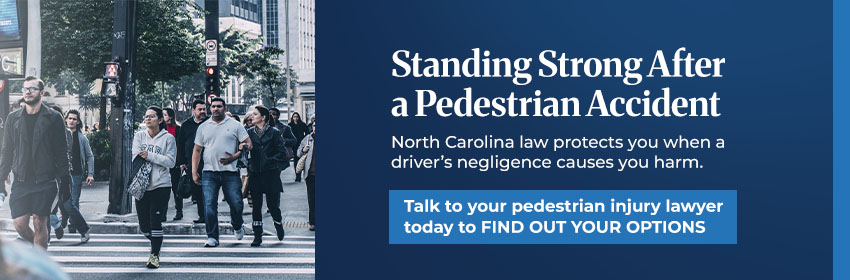
North Carolina law adds another layer of difficulty. Our state follows the strict contributory negligence rule, which means that if you are found even one percent at fault for your accident, you may be barred from recovering compensation. Insurance companies are aware of this and use it to their advantage, searching for ways to argue that pedestrians are partially at fault. At Galbavy Law, we counter those arguments by building strong cases that demonstrate the full responsibility of negligent drivers.
Pedestrian safety is not just a personal issue; it is a public concern. According to the National Highway Traffic Safety Administration, thousands of pedestrians are injured or killed nationwide each year, and North Carolina is not immune to this reality. These statistics underscore the importance of legal advocacy for those who have been harmed and the need for preventive measures in the communities we serve.
If you or a loved one has been struck while crossing a street in Charlotte, walking near a school zone in Raleigh, or navigating a crosswalk in Greensboro or Asheville, you do not have to face the fight alone. At Galbavy Law, we treat every pedestrian accident case with the seriousness it deserves, because we know the stakes are nothing less than your health, your financial security, and your future.
Every pedestrian in North Carolina has rights on the road, but enforcing those rights after an accident is often an uphill battle. By law, you are entitled to seek compensation for your medical bills, lost income, pain and suffering, and property damage if you are injured due to someone else’s negligence. In cases of permanent impairment, you also have the right to pursue damages that reflect the lifelong impact of your condition.
The challenge is that North Carolina is one of the few states that applies a pure contributory negligence rule. Under this rule, if an insurance company or a jury finds that you were even slightly at fault, your claim may be denied altogether. Something as minor as crossing a street outside of a marked crosswalk in Raleigh or stepping off the curb too quickly in downtown Charlotte could be used as a reason to argue against your recovery. This strict standard is one of the most significant challenges that pedestrian accident victims face.
Another key factor in pedestrian claims involves crosswalk protections. State law requires drivers to yield to pedestrians in designated crosswalks, and failure to do so is considered negligence. Unfortunately, drivers often ignore these rules, especially in busy intersections around Greensboro and Asheville, where traffic signals and multiple lanes create confusing conditions. For injured pedestrians, proving that a driver failed in this duty can be the difference between full compensation and nothing at all.
Helmet laws do not apply to pedestrians; however, other safety considerations may still be relevant. For instance, if you were walking at night without reflective clothing, an insurance company may argue that you contributed to the accident. These arguments do not always hold up in court, but they highlight the aggressive tactics insurers use under North Carolina’s contributory negligence framework.
At Galbavy Law, our team knows how to effectively push back against insurance companies. With a background as a former insurance defense attorney, they possess an in-depth understanding of the strategies used by insurers and the methods to counter them with compelling evidence. The firm acts swiftly to obtain essential documents, such as police reports, medical records, and witness statements, that establish the driver's fault and safeguard their clients' rights. They also emphasize the severity of their clients' injuries, particularly in cases involving orthopedic trauma, surgeries, and permanent impairments that insurance companies often attempt to downplay.
Pedestrians also have the right to pursue claims against other responsible parties beyond the driver. If a poorly maintained crosswalk or malfunctioning traffic light in Raleigh contributed to your accident, a municipality may be held accountable. If a defective vehicle part caused a driver to lose control, the manufacturer may share responsibility. Identifying all responsible parties is crucial for maximizing recovery.
The North Carolina General Assembly outlines traffic laws designed to protect pedestrians, but having rights on paper is not enough. Exercising them requires an attorney who knows how to build strong cases in a system that is often stacked against victims. At Galbavy Law, we combine legal expertise, medical knowledge, and local experience to make sure pedestrians’ rights are more than just words; they are protections that lead to real results.
For many of our clients, the claims process after a pedestrian accident feels as painful and confusing as the injuries themselves. You may be dealing with broken bones, surgeries, or long rehabilitation periods while also trying to answer calls from insurance adjusters and manage bills that arrive daily. At Galbavy Law, our goal is to simplify this process, protect your rights, and make sure no detail is overlooked.
The first step is always medical care. Your health comes first, and from a legal perspective, your medical records become the foundation of your claim. Orthopedic injuries are among the most common in pedestrian accidents, whether from fractures, joint damage, or spinal trauma. These injuries often require surgical intervention and months of therapy. By seeking immediate care, you not only protect your health but also create a clear link between the crash and your medical condition, which is essential for proving damages later.
Once medical needs are addressed, reporting the accident is critical. Always make sure a police report is filed, even if the driver offers to pay out of pocket or insists it is unnecessary. Official documentation helps establish the facts of the incident, and law enforcement officers trained in traffic investigations can provide key evidence. The North Carolina Department of Transportation offers resources on traffic crash reporting and pedestrian safety, providing explanations of the crash data required and emphasizing the importance of formally documenting these events.
After the initial report, insurance companies typically act swiftly. Adjusters may reach out within days, requesting statements or persuading claimants to accept a quick settlement. It's crucial to understand that these offers are often not equitable. Insurers are aware that medical expenses can accumulate rapidly, and they hope individuals will agree to less than what they truly deserve due to financial pressure.
Having previously worked as an insurance defense attorney, the advisor is well-versed in the tactics adjusters employ during these early interactions. For this reason, they strongly recommend that clients refrain from communicating with the insurance company until they have thoroughly reviewed the case together.
When you contact our office, we begin with a free consultation. We want to hear your story, understand how the accident happened, and review the immediate impact on your health and daily life. From there, we launch a thorough investigation. This may include obtaining surveillance footage from nearby businesses in Charlotte, collecting witness statements from pedestrians in Raleigh, or analyzing traffic light data from intersections in Greensboro and Asheville. In cases on highways like I-40 or I-85, we may also consult accident reconstruction experts who can demonstrate precisely how the driver’s negligence caused the crash.
As the investigation progresses, we work closely with your doctors to gather records, imaging, and expert opinions that detail the severity of your injuries and the treatments you will need in the future. For example, if your orthopedic injury requires additional surgeries or results in permanent limitations, we ensure that these future medical costs are included in your claim. We also evaluate lost income, diminished earning capacity, and the long-term effect on your quality of life.
Once the evidence is gathered, the attorney presents a demand package to the insurance company. This package outlines the driver’s negligence, documents the client's injuries, and specifies the full extent of their damages. Following the submission, negotiations ensue, where experience becomes crucial. Having formerly represented insurers, the attorney can anticipate potential objections, prepare strategic responses, and effectively counter any attempts to diminish the client’s claim.
If the insurer refuses to make a fair offer, we are fully prepared to take your case to court. Litigation involves filing a lawsuit, participating in discovery, and ultimately presenting your case before a jury. While many cases resolve before trial, being ready for court from day one strengthens your position in negotiations. Insurers know that Galbavy Law is not afraid to fight for our clients, and that readiness often leads to better settlements.
Throughout the process, communication is key. Many clients tell me that one of their biggest fears is being left in the dark about their case. At Galbavy Law, we make sure that never happens. You will always know the status of your claim, the next steps in the process, and our strategy moving forward. We handle the legal burden so you can focus on healing, while keeping you informed to ensure you feel confident in every decision made.
The pedestrian accident claims process in North Carolina can be challenging, particularly with the added complexity of contributory negligence rules. But with the proper representation, it is a process you do not have to face alone. At Galbavy Law, we turn complexity into clarity and obstacles into opportunities for justice.
Pedestrian accidents can happen anywhere, from bustling city streets in Charlotte to quiet neighborhoods in Asheville, but specific patterns appear again and again. Understanding these common causes is important because insurers often attempt to blame the pedestrian, particularly under North Carolina’s strict contributory negligence rule. At Galbavy Law, we thoroughly investigate each crash to reveal the true causes and hold negligent parties accountable.
One of the leading causes is driver distraction. A motorist glancing at a phone, adjusting GPS, or even eating while driving may miss a pedestrian in a crosswalk. Distracted driving is particularly hazardous at busy intersections in Raleigh and Greensboro, where heavy traffic and multiple lanes create complex conditions. According to the Centers for Disease Control and Prevention, distracted driving is a national crisis, and pedestrians are often the ones who suffer most.
Failure to yield is another frequent cause. North Carolina law requires drivers to yield to pedestrians in marked crosswalks; however, many drivers fail to comply with this requirement. Left-turn accidents are hazardous, as drivers often misjudge a pedestrian’s speed or simply fail to look. In Charlotte’s Uptown or downtown Asheville, where foot traffic is high, failure-to-yield collisions can cause catastrophic injuries.
Speeding and aggressive driving also contribute to many pedestrian crashes. Drivers speeding along I-40 near Raleigh or weaving through traffic on I-85 near Greensboro have less time to stop for someone crossing the street. Even at lower speeds in urban areas, aggressive driving behaviors like running red lights or ignoring stop signs frequently put pedestrians at risk.
Alcohol and drug impairment remain persistent issues. An impaired driver has reduced reaction times and poor judgment, making it much more likely they will hit someone on foot. Victims of these crashes often suffer orthopedic injuries, head trauma, or permanent impairments. These cases may also allow for punitive damages, since impaired driving is considered reckless behavior.
Poor visibility and weather conditions also play a role. Pedestrians walking at night in Raleigh suburbs or on foggy mornings in the Asheville mountains are harder to see. However, this does not excuse negligent driving. Motorists are required to adjust their driving to conditions. When they fail to do so, they can be held liable for the harm they cause.
Road design and maintenance are additional factors. Poorly marked crosswalks, inadequate lighting, or malfunctioning traffic signals increase the risk of accidents. When municipal negligence contributes to unsafe conditions, local governments may share responsibility. The Federal Highway Administration acknowledges that infrastructure plays a crucial role in pedestrian safety and offers guidance on how cities can mitigate risks.
At Galbavy Law, we have handled pedestrian accident cases involving all of these causes. From distracted driving collisions in Charlotte to impaired driving crashes in Asheville, we know the patterns and how to build cases that cut through insurance company excuses. Our focus is always on proving that the driver’s negligence, not the pedestrian’s actions, caused the harm.
Following a pedestrian accident, the primary focus is on covering expenses and rebuilding lives. North Carolina law permits victims to pursue compensation that accounts for the complete effect of their injuries, but insurers seldom agree to pay full amounts without detailed, well-documented claims. Galbavy Law carefully organizes cases to make sure every category of damages is addressed.
Medical costs are usually the most significant component of a pedestrian injury claim. These cases often involve severe orthopedic trauma and long recovery horizons.
Medical research indicates that orthopedic and spinal injuries often require continuous rehabilitation; fair compensation should consider both current expenses and anticipated future treatment costs.
Injuries frequently disrupt employment—sometimes permanently.
Short context: Properly valuing wages means looking beyond today’s pay stubs to the career trajectory that was derailed by the collision.

Pedestrians don’t have vehicle damage—but personal items matter.
Short context: These items may seem minor compared to medical bills, but they’re part of the complete financial picture.
The law recognizes the human toll of being struck by a vehicle.
Short context: These losses don’t come with invoices, but they are real, compensable harms that must be meaningfully valued.
Long-term limitations often define pedestrian cases.
Short context: When walking, standing, or balance is permanently affected, compensation must reflect permanence, not just the initial hospital stay.
Punitive damages may be available to punish and deter reckless or intentional conduct.
Short context: While less common, punitive damages can significantly increase recovery when the at-fault conduct crosses the line into recklessness.
Insurers often focus narrowly on initial bills and disregard future needs. A comprehensive case includes:
Short context: Galbavy Law has recovered over $25 million for injured North Carolinians in Charlotte, Raleigh, Greensboro, Asheville, and beyond by refusing lowball offers and documenting the true scope of loss.
Pedestrian accident compensation extends beyond just covering bills; it focuses on stability and recovery, including treatment costs, safeguarding income, and addressing the impact of life changes following severe injuries. Victims, through dedicated advocacy, can seek damages across all categories, allowing them to move forward with confidence.
Why Hiring a North Carolina Pedestrian Accident Lawyer Matters
Trying to handle a pedestrian accident claim alone is difficult, especially in North Carolina, where the contributory negligence rule can prevent recovery if you are found even slightly at fault. Insurance companies move quickly, often reaching out to injured pedestrians or their families within days of the accident. Their goal is to gather statements that weaken your case or to offer a fast settlement that does not come close to covering long-term medical care, lost wages, or the emotional toll of the injury.
Hiring a North Carolina pedestrian accident lawyer means leveling the playing field. A lawyer can investigate the crash, secure witness testimony, review police reports, and work with medical providers to show the full extent of your injuries. An experienced crosswalk accident attorney NC families rely on also understands how to counter the arguments insurers make about distraction, jaywalking, or visibility. These strategies are often used to shift blame, but with proper representation, you can effectively protect your rights and interests.
Victims and their families can also turn to NCDOT’s Watch for Me NC program, the state’s pedestrian & bicyclist safety outreach and enforcement campaign, and the FHWA’s Safe Transportation for Every Pedestrian (STEP) program, which offers design tools, countermeasure guidance, and peer-reviewed safety strategies. These practical insights, paired with experienced legal advocacy, help build a claim that realistically captures both the facts and the consequences of the harm.

At Galbavy Law, every case is approached with personal attention and care. David Galbavy, a Board-Certified Specialist in Workers’ Compensation and a former insurance defense attorney, leads the firm. His unique background equips him with invaluable insights when representing pedestrians who have suffered injuries in Charlotte, Raleigh, Greensboro, Asheville, and across North Carolina. With a deep understanding of how insurers evaluate claims, the arguments they employ, and the strategies they use to evade full compensation, David is dedicated to utilizing that expertise to advocate fiercely for injured North Carolinians.
Our firm has recovered over $ 20 million for clients, including those who suffered orthopedic injuries, underwent multiple surgeries, and sustained permanent impairments. Many of these injuries are common in pedestrian accidents, where victims often sustain broken bones, spinal trauma, or head injuries that change their lives permanently. By working with orthopedic specialists and rehabilitation experts, we ensure that every long-term consequence is part of your claim.
What sets Galbavy Law apart is a commitment to client communication. Unlike larger firms where cases are passed between staff, our clients work directly with me and a small, dedicated team. We answer calls, provide updates, and make sure you understand each step of the process. Local knowledge also matters. Whether the crash occurred at a busy crosswalk in downtown Raleigh, along I-40 outside Greensboro, or near a school zone in Charlotte, we are familiar with the courts, roads, and challenges unique to each area.
Call 911 so law enforcement and emergency responders can document the incident and provide care. Even if injuries appear minor, get medical attention because many conditions worsen over time. The North Carolina Department of Health and Human Services offers information on emergency resources and treatment programs that may be useful after an accident.
North Carolina follows the strict contributory negligence rule, meaning if you are found even one percent at fault, you may lose your right to recover damages. Insurance companies often try to argue that the pedestrian was distracted or crossing improperly. An experienced NC pedestrian rights lawyer can counter these claims with evidence and expert testimony.
Generally, the statute of limitations for personal injury claims is three years from the date of the accident, and for wrongful death claims, it is two years. Delaying can result in losing your right to compensation. The North Carolina Judicial Branch provides public information on filing deadlines and court processes.
Compensation can cover medical costs, future treatments, lost wages, reduced earning ability, property damage, pain and suffering, and sometimes punitive damages. Since pedestrian injuries frequently involve fractures, head trauma, or spinal injuries, assessing future requirements is crucial.
At Galbavy Law, there are no upfront costs. We work on a contingency fee basis, which means we only collect a fee if we successfully obtain compensation on your behalf. Consultations are always free.
Sometimes, municipalities or state agencies may be partially liable, especially if a poorly designed or poorly maintained crosswalk contributed to the crash. Claims against government entities are subject to specific procedures and deadlines, so consulting a pedestrian injury lawyer in North Carolina is particularly important for families involved.
Pedestrian accidents often result in victims facing extended hospital stays, lost income, and uncertainty about what lies ahead. In a state with some of the strictest negligence laws in the country, it is crucial to have experienced legal guidance from the start. At Galbavy Law, we have assisted clients across Charlotte, Raleigh, Greensboro, Asheville, and nearby communities along I-40 and I-85 in recovering the compensation they deserve.
With credentials as a Board-Certified Specialist in Workers’ Compensation and a background as a former insurance defense attorney, the firm possesses a deep understanding of the legal and medical intricacies surrounding serious injuries. They have successfully recovered over $25 million for clients in North Carolina, frequently in cases involving orthopedic injuries, surgeries, and permanent impairments.
If you or a loved one has been struck while walking, you do not need to face the legal system alone. Contact Galbavy Law today by completing our contact form to schedule a complimentary consultation. There are no upfront fees, and your case will be treated with the seriousness it deserves from the very first conversation.

1 Prior results do not guarantee similar outcomes in future cases because each case is unique and must be evaluated separately. The only way we can assist you is for you to call us about your case.
Protected by reCAPTCHA. Google Privacy Policy and Terms of Service apply.