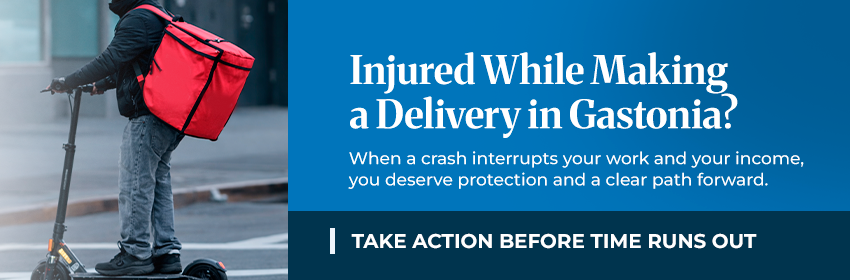
Delivery work keeps Gastonia moving, but it also exposes drivers to real risks every day. Injuries can happen while loading trucks, driving delivery routes near Franklin Boulevard or I-85, or walking on customer and business properties throughout the city.
There are two common categories of people injured in delivery-related incidents:
This page focuses on delivery drivers who were injured while working.
If you were injured by a delivery driver, your claim may be better addressed under a different legal framework. In those situations, please see:
For injured delivery drivers, the circumstances are different. A single injury can involve workers’ compensation benefits, auto insurance, and sometimes additional third-party claims. Understanding how those systems interact is often the key to receiving full compensation.
Delivery driver injury claims are different because one injury can trigger more than one legal claim at the same time. Unlike many other jobs, delivery driving combines physical labor, constant driving, and frequent entry onto other people’s property. As a result, injured drivers often face overlapping legal systems, including workers’ compensation, auto insurance, and premises liability.
For example, a delivery driver may:
Each of these scenarios raises different legal and insurance questions. Workers’ compensation may apply because the injury happened on the job. At the same time, a separate claim may exist against a negligent driver, a property owner, or another third party. Identifying every available claim early helps avoid gaps in coverage and lost benefits.
Yes. Many injured delivery drivers in Gastonia have more than one claim arising from a single incident. This overlap is common and often misunderstood. A single injury may involve:
For example, if a delivery driver is rear-ended near an I-85 interchange while making deliveries, workers’ compensation may cover medical treatment and lost wages. At the same time, the driver may also have a personal injury claim against the at-fault motorist. Both claims must be handled carefully, because decisions in one case can affect the value of the other.
Mistakes early in the process (such as incomplete reporting or inconsistent medical documentation) can limit benefits later. Coordinating all claims from the beginning helps protect the injured driver’s overall recovery.
Experience matters in delivery driver injury cases because these claims often involve multiple legal systems. An injured delivery driver may have a workers’ compensation claim, a third-party auto injury claim, or a premises liability claim arising from the same incident. Decisions made in one case (such as medical treatment, reporting, or settlement timing) can directly affect the value of the others.
At Galbavy Law, injured delivery drivers are represented by a North Carolina board-certified workers’ compensation specialist, a credential held by only a small number of attorneys in the state. This matters because workers’ compensation often serves as the foundation of a delivery driver's injury case, even when additional third-party claims are involved.
Many law firms divide these cases among different attorneys: one handles workers’ compensation, and another handles personal injury claims. That approach can lead to inconsistent strategies, missed deadlines, and reduced settlements. Decisions made in a workers’ compensation case can directly affect the outcome of an auto accident or premises liability claim.
Handling all related claims together allows for consistent medical documentation, coordinated settlement timing, and a clearer understanding of how each claim affects the others.
Delivery drivers in Gastonia may be employees or independent contractors, and that classification affects how injury claims are handled. Drivers perform delivery work under many different arrangements, even when vehicles look similar on the road.
Some are treated as employees under North Carolina law, while others are classified as independent contractors through app-based delivery platforms. That distinction can affect whether workers’ compensation applies and which insurance policies may be available.
Drivers working for traditional delivery companies (such as UPS, FedEx, Amazon delivery service partners, and regional courier services) are often classified as employees. In most cases, that means workers’ compensation benefits are available if the driver is injured while working.
Drivers for the United States Postal Service are covered under federal workers’ compensation rather than North Carolina’s system. Although the benefits structure differs, injured postal workers still have specific rights and procedures that must be followed.
Federal workers’ compensation benefits for postal employees are governed by the Federal Employees’ Compensation Act, which is administered by the U.S. Department of Labor.
Drivers working in the gig economy, such as DoorDash, Uber Eats, Instacart, and Amazon Flex, are usually classified as independent contractors rather than employees. Because of this, workers’ compensation generally does not apply.
Coverage for injuries typically depends on:
Coverage gaps are common in these cases, so it’s critical for gig drivers to understand which policies may respond if they are injured.

Most employee delivery drivers in Gastonia can receive workers’ compensation benefits if they are injured while working, even if no one else caused the accident.
Workers’ compensation benefits generally include medical treatment related to the injury, partial wage replacement, and disability benefits when injuries cause lasting impairment. These benefits apply even if the delivery driver caused the accident, even if no other party was at fault, and even in single-vehicle incidents.
Workers’ compensation does not compensate for pain and suffering. When a third-party claim exists, careful coordination is required to protect the injured driver’s total recovery.
North Carolina’s workers’ compensation system is overseen by the North Carolina Industrial Commission, which administers claims and resolves disputes.
If you were hurt loading a truck or working in a warehouse, the injury is usually considered work-related, which means workers’ compensation benefits may apply. These injuries often involve lifting, repetitive motion, slips, or equipment issues and can happen before a delivery route even begins.
In some cases, a warehouse injury may also involve a third party, such as defective equipment or unsafe premises owned by another company. Identifying all potential claims early helps protect your full recovery.
Many delivery driver injuries occur before a route ever begins. Loading trucks, sorting packages, and working in warehouses can place heavy physical strain on drivers and expose them to unsafe conditions.
However, not every warehouse injury is limited to workers’ compensation. In some cases, a third party may share responsibility. For example, defective loading equipment, unsafe premises owned by another company, or negligent maintenance can create an additional claim beyond workers’ comp.
Proper documentation is especially important in these cases. Injured drivers should ensure that job duties, the location of the injury, witness information, and incident reports are accurately recorded. Small details can later determine whether additional compensation is available beyond workers’ compensation benefits.
If you were injured while making a delivery on someone else’s property, your injury may involve both workers’ compensation and a premises liability claim. Because the injury occurred during work duties, workers’ compensation may apply, and if unsafe conditions such as broken steps, poor lighting, slippery surfaces, or an aggressive dog contributed to the injury, the property owner may also be responsible.
Whether a separate claim exists depends on who controlled the property, whether the hazard was known or should have been discovered, and whether you were lawfully on the property at the time of the delivery.
If you were injured in a vehicle crash while making deliveries, you may have both a workers’ compensation claim and, in some cases, a separate claim against another at-fault driver. Workers’ compensation can apply because the injury happened while you were working, even in a single-vehicle crash. If another driver caused the accident, you may also be able to pursue an auto injury claim, and coordinating both claims carefully is important to protect your full recovery.
Crashes frequently occur on major routes such as Franklin Boulevard and Cox Road, and near I-85 interchanges, where delivery vehicles mix with commuter traffic and pedestrians, and there are frequent stops. When a delivery driver is injured in a crash while working, workers’ compensation may apply even if the accident involved a vehicle.
Not all delivery crashes involve another driver. Bad weather, road debris, poor visibility, or sudden hazards can cause a driver to lose control and crash.
In these situations, workers’ compensation benefits may still be available because the injury occurred during work duties. Depending on the insurance policy, auto insurance benefits such as MedPay or uninsured/underinsured motorist coverage may also apply. These cases still require careful documentation to establish work status at the time of the crash.
When another motorist causes a crash, injured delivery drivers often have both a workers’ compensation claim and a separate personal injury claim against the at-fault driver. These claims proceed under different laws and must be coordinated carefully.
Medical treatment obtained through workers’ compensation often becomes critical evidence in the third-party injury claim. Inconsistent treatment or gaps in care can weaken recovery in both cases. Coordinating medical documentation and timelines helps protect the full value of the injured driver’s claims.
North Carolina crash reporting requirements and accident documentation are governed by state transportation rules. Official crash reports often play a central role in establishing how an accident occurred and who was involved.
Yes. Many delivery driver injuries involve third parties whose negligence contributed to the harm. These claims exist separately from workers’ compensation and can provide compensation that workers’ comp does not.
Third-party claims may involve at-fault drivers, property owners, equipment manufacturers, or maintenance providers. Identifying these claims early helps avoid missed recovery opportunities.
If another driver caused a crash while you were delivering, you may pursue a personal injury claim against that driver. These claims may provide access to liability insurance and uninsured or underinsured motorist coverage. Unlike workers’ compensation, auto negligence claims may allow recovery for pain and suffering, which is often significant in serious delivery-related crashes.
Premises liability claims may apply when delivery drivers are injured due to unsafe conditions on residential or commercial properties. These claims focus on whether the property owner failed to maintain reasonably safe conditions or warn of known hazards.
Defective trucks, ramps, dollies, or other delivery equipment can also create product or equipment liability claims. These cases may involve manufacturers, distributors, or maintenance companies whose actions contributed to the injury.
Workers’ compensation often affects third-party settlements through a legal concept known as subrogation. When a workers’ compensation carrier pays benefits, it may have a right to reimbursement from any third-party recovery.
This does not mean injured delivery drivers lose their third-party claims, but it does mean settlements must be handled strategically. Poor coordination can result in reduced net recovery after liens are satisfied.
North Carolina law governs how workers’ compensation liens apply and when they may be reduced or negotiated. Understanding these rules is critical when multiple claims arise from the same injury.
Coordinating workers’ compensation and third-party claims helps protect the injured driver’s overall financial recovery and avoid unnecessary legal conflicts.

Delivery driver injury cases often involve multiple layers of proof. Evidence must establish not only the injury itself, but also whether the driver was working, what duties were being performed, and whether any third parties contributed to the harm.
Common steps in building a delivery driver injury case include:
In vehicle-related delivery injuries, official crash documentation often plays a key role. North Carolina crash reports help establish when and where an accident occurred, which vehicles were involved, and whether citations were issued. Early investigation matters. Evidence such as digital logs, app data, or surveillance footage may be lost or overwritten if not preserved promptly.
After a delivery driver injury in Gastonia, you should seek medical care as soon as possible and report the injury according to your employer’s or delivery platform’s requirements. It’s also important to document how the injury happened, preserve any photos, reports, or witness information, and avoid giving recorded statements to insurers before understanding your rights. Early action helps protect both your health and any benefits or claims that may be available.
These are the important steps:
Workers’ compensation claims in North Carolina are overseen by specific statutory rules and procedures. Understanding reporting requirements and benefit timelines can help injured drivers avoid delays or denials.
Delivery companies and insurance carriers often act quickly after an injury. Early guidance can help injured drivers avoid mistakes that may limit benefits later.
It matters who represents an injured delivery driver because these cases often involve multiple claims, including workers’ compensation and third-party injury claims. Decisions made in one case can affect the outcome of another, and poor coordination can reduce overall compensation.
A lawyer experienced with delivery driver injuries understands how to manage overlapping claims, insurance issues, and workers’ compensation liens to protect the driver’s full recovery. Choosing representation with experience handling delivery driver injuries helps protect benefits, preserve third-party claims, and maximize overall recovery.
Most delivery drivers who are classified as employees can receive workers’ compensation benefits if they are injured on the job. Benefits may apply even if the driver caused the accident or no one else was at fault.
Injuries on customer or business property may involve workers’ compensation and, in some cases, a premises liability claim against the property owner.
Yes. Injured delivery drivers may have both a workers’ compensation claim and a third-party auto injury claim against the at-fault driver.
Single-vehicle crashes may still qualify for workers’ compensation if the injury occurred during work duties. Auto insurance benefits may also apply depending on the policy.
Coverage depends on the classification, the app's activity, and the insurance policies in effect at the time of injury. These cases often require early investigation.
Workers’ compensation insurers may have a lien on third-party recoveries. Proper coordination helps protect the injured driver’s net recovery.
Handling all related claims together helps avoid conflicting strategies and reduces compensation.
Early conversations often help clarify benefits, preserve evidence, and prevent avoidable mistakes.
Galbavy Law represents injured delivery drivers throughout Gastonia and the surrounding communities. The focus is on helping drivers understand their options and coordinating workers’ compensation and third-party claims under a single legal strategy.
Injured delivery drivers work directly with a North Carolina board-certified workers’ compensation specialist who has experience handling complex, multi-claim injury cases. This coordinated approach helps protect benefits, address insurance issues, and pursue full compensation when third-party claims apply.
To discuss your situation and learn about available options, call us at 704-412-4466 to schedule a consultation. There is no obligation to move forward, and the goal is to provide clear guidance so injured delivery drivers can focus on recovery.

1 Prior results do not guarantee similar outcomes in future cases because each case is unique and must be evaluated separately. The only way we can assist you is for you to call us about your case.
Protected by reCAPTCHA. Google Privacy Policy and Terms of Service apply.